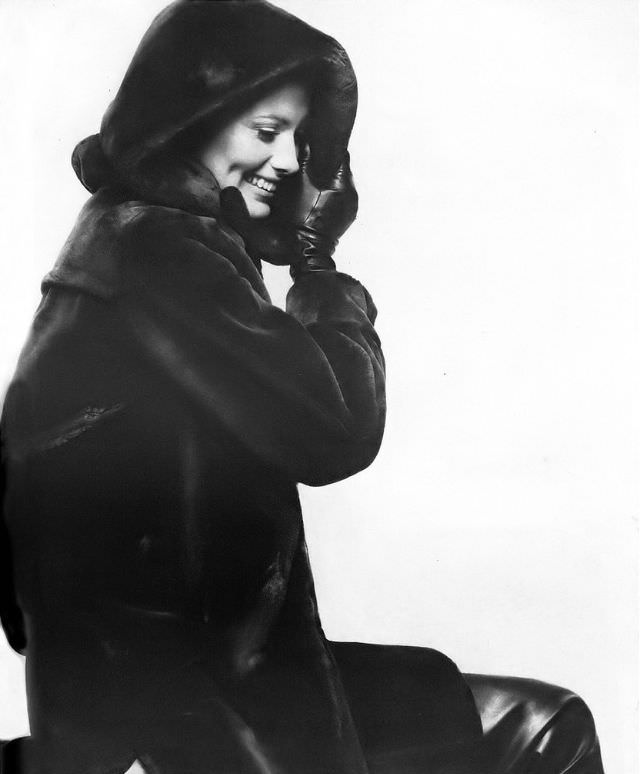
Turned in profile against a clean, pale backdrop, Maud Adams wears a hooded sheared Alaska seal fur coat that reads as both cocoon and statement. The oversized hood frames her face like a soft halo, while her gloved hand pulls the edge close, emphasizing texture, warmth, and the sculptural volume of the outerwear. A quiet smile breaks through the heavy silhouette, giving the fashion portrait a candid, intimate spark.
Gianni Penati’s Vogue photograph from 1969 leans into high-contrast simplicity, letting light skim across the fur’s velvety surface and the smooth sheen of dark gloves. The styling favors minimal distraction—no busy set, no competing accessories—so the viewer’s eye travels between the curve of the hood, the gentle drape of the coat, and the poised line of her seated posture. It’s a classic example of late-1960s editorial photography where mood and material do as much storytelling as the model.
Beyond its immediate glamour, the image sits at the intersection of fashion and culture, reflecting an era when luxury outerwear and cinematic elegance shaped magazine ideals. The portrait also resonates with Maud Adams’ later public persona, balancing approachable warmth with a polished, self-possessed aura that editors loved. For collectors of Vogue history, 1960s fashion imagery, and iconic fur-coat editorials, this photograph remains a crisp, memorable study in winter sophistication.