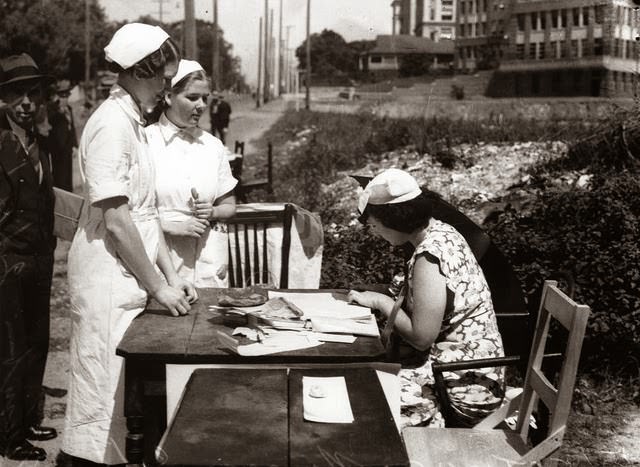
Morning light and hospital-white uniforms set the tone as Brisbane nurses step forward to vote on Election Day in 1938, turning a routine civic duty into a quietly dramatic street-side scene. The women wait with composed patience, caps crisp and sleeves rolled for practical work, while a small crowd hovers behind them. Against the backdrop of poles, roadway, and distant buildings, the moment feels both ordinary and momentous—democracy conducted between shifts.
At the table, an election worker bends over paperwork, pen poised above forms, as documents and envelopes lie scattered in neat disorder across the wooden surface. The nurses lean in, attentive and businesslike, their posture suggesting familiarity with rules and procedure—skills honed in wards now applied to the ballot. Details of dress matter here: the clean lines of nursing attire contrast with patterned daywear, underscoring how uniform and identity intersected in public life.
Brisbane in the late 1930s comes into focus through this candid slice of Australian social history, where voting, gender, and professional respectability meet on the same tabletop. For readers drawn to Fashion & Culture, the photograph offers more than uniforms; it captures the codes of appearance, decorum, and participation that shaped how women were seen—and how they claimed space—in civic settings. As a historical photo of nurses voting, it invites reflection on the everyday mechanics of elections and the people who kept both hospitals and public institutions running.