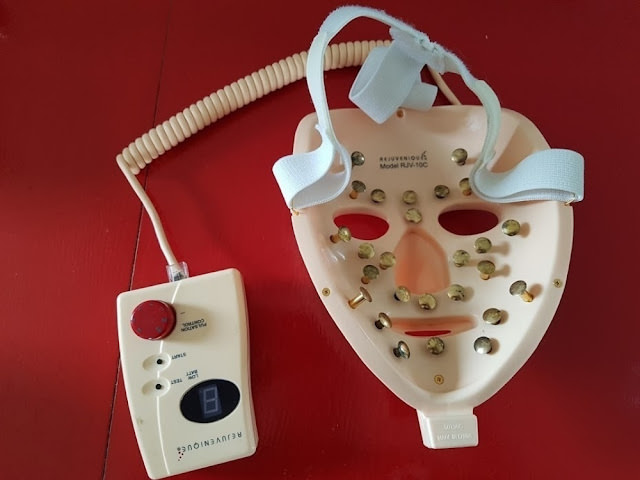
Against a stark red background sits a plastic facial mask that looks more like a prop from science fiction than a beauty aid, its smooth, pale surface punctured by eye and mouth openings. Dozens of small metal contacts stud the front, arranged to press against key areas of the face, while white straps arc over the top to hold it in place. A coiled cord snakes away to a handheld controller, tying the mask to the promise of powered “exercise” rather than creams or serums.
The controller’s simple buttons and small display suggest an at-home device meant to be switched on, adjusted, and endured for results, echoing late-20th-century faith in gadgets as shortcuts to self-improvement. Electricity, here, is marketed as a kind of invisible personal trainer for facial muscles, aiming to tighten skin and reduce wrinkles through pulsed stimulation. The clinical hardware—contacts, wiring, and settings—contrasts sharply with the intimate goal of smoothing a human face.
Seen through the lens of 1999 fashion and culture, the mask reflects an era when beauty technology blurred into medical aesthetics, and consumers embraced increasingly mechanized routines. Its unsettling appearance is part of its historical fascination: the same features that make it “creepy” also signal seriousness, innovation, and a desire to professionalize home skincare. As a relic of turn-of-the-millennium anti-aging trends, it captures the anxious optimism of the period—where the future of youthfulness seemed only a button-press away.