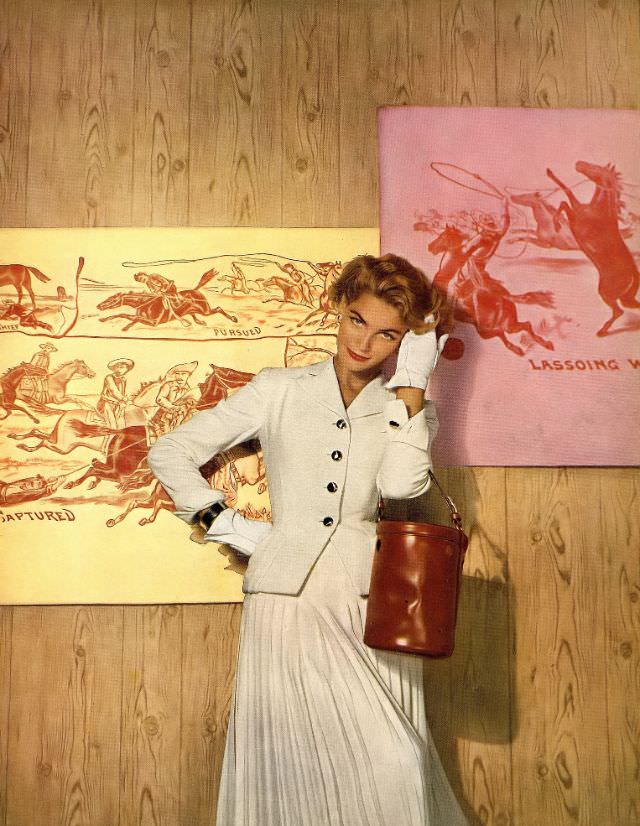
Georgia Hamilton poses with an easy, knowing elegance, dressed head to toe in a crisp white worsted suit whose clean lines feel unmistakably mid-century. The fitted jacket closes with dark buttons that punctuate the bright fabric, while a finely pleated skirt falls in soft, even rhythm, catching the studio light and emphasizing movement even in stillness. White gloves and a sculpted coiffure complete the polished Harper’s Bazaar look associated with December 1952’s fashion pages.
Against wood-paneled walls, bold Western-themed illustrations add a playful sense of narrative—horses in motion, riders in pursuit, and lassoing scenes that contrast with the outfit’s refined urbanity. That tension between rugged Americana and couture restraint was a familiar editorial strategy in postwar fashion photography, using sets and props to create mood rather than merely document clothing. Hamilton’s relaxed lean and tilted gaze turn the tableau into a story, not just a styling exercise.
A leather bucket bag by Josef hangs at her arm, its warm brown tone acting as the image’s most striking counterpoint to the white ensemble. The accessory reads as practical yet luxurious, suggesting travel, shopping, or a day spent in the city, while remaining graphic enough to anchor the composition. Together with Paul Parnes’s tailored suit and the skirt’s precise pleating, the photograph becomes a searchable snapshot of 1950s women’s fashion—where impeccable tailoring, statement accessories, and editorial imagination met on the pages of Harper’s Bazaar.