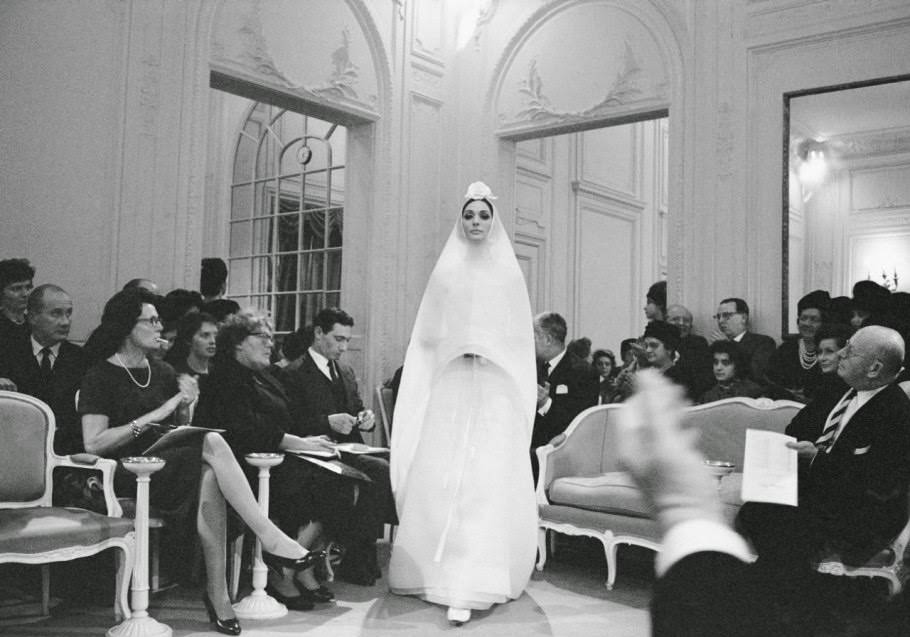
Beneath the lofty arches of Dior’s Grand Salon, Kouka advances with the poised restraint of a couture runway, her wedding ensemble falling in smooth, uninterrupted lines. The look reads as a study in controlled volume—veil-like layers framing the face, a sleek column beneath, and a softly sculpted headpiece that anchors the silhouette. Around her, the room’s ornate moldings and tall windows heighten the contrast between old-world interiors and the modern clarity of early-1960s haute couture.
On either side, the seated audience forms a living border to the presentation, dressed in dark tailored suits and elegant daywear that underscores the ceremony of a fashion house showing. Their attentive posture, programs in hand, suggests an event where clients, press, and insiders watched details closely: fabric behavior, construction, and the way a bridal look moved through space. Even the low salon tables and curved sofas speak to the intimate format of couture, where garments were experienced at close range rather than from a distant stage.
Spring–Summer 1961 appears here not as an abstract season label but as an atmosphere—refined, formal, and meticulously orchestrated inside one of fashion’s most mythologized rooms. For readers drawn to Christian Dior’s legacy and the culture of Paris couture, this photograph offers more than a dress; it captures the choreography of presentation, the quiet authority of a model’s walk, and the enduring fantasy of a Dior bridal moment rendered in clean, luminous white.