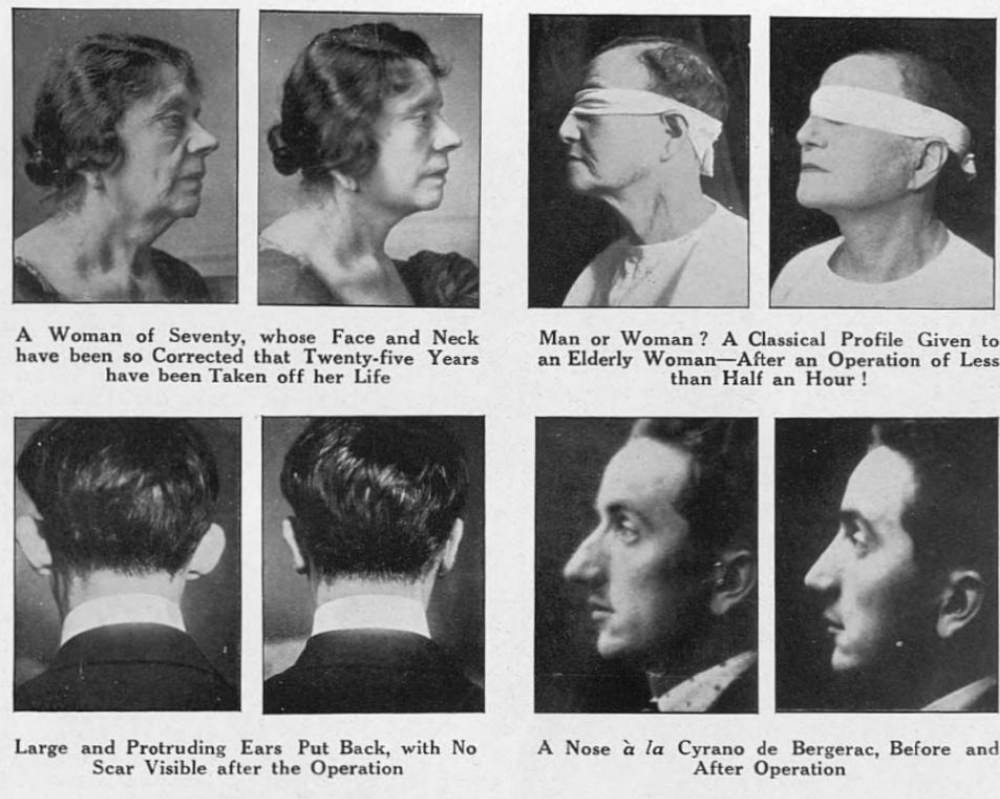
Across a grid of small portraits, the viewer is led through a 1920s–1930s fascination with surgical “before and after” proof, presented with the brisk confidence of a newspaper or magazine feature. Side profiles dominate, inviting comparison of noses, chins, and necklines as though they were fashion details, while the captions promise dramatic results—years “taken off” a face and a “classical profile” achieved in under an hour. The layout feels equal parts medical documentation and popular entertainment, a window into how modern cosmetic surgery entered everyday conversation.
One sequence focuses on an elderly woman’s profile, with careful lighting and repeat angles that suggest a studio-like attempt at objectivity. Another set shows a patient with eyes bandaged, underscoring both the clinical reality and the period’s casual willingness to display recovery in public print. Even without naming surgeons or clinics, the message is clear: rhinoplasty and related procedures were being marketed not only as corrective medicine, but as a route to social ease, youthfulness, and the era’s preferred facial proportions.
Below, additional panels widen the theme beyond nose jobs, including ears “put back” and a particularly emphatic example of a prominent nose likened to Cyrano de Bergerac, then reshaped into a straighter silhouette. The language of the captions—bold, definitive, and sometimes unkind—reveals the beauty standards and anxieties of the interwar years, when film, advertising, and mass media sharpened ideals of the “right” profile. Taken together, the montage is a concise history lesson in early cosmetic surgery, where fashion culture, medical innovation, and the politics of appearance intersect on a single page.