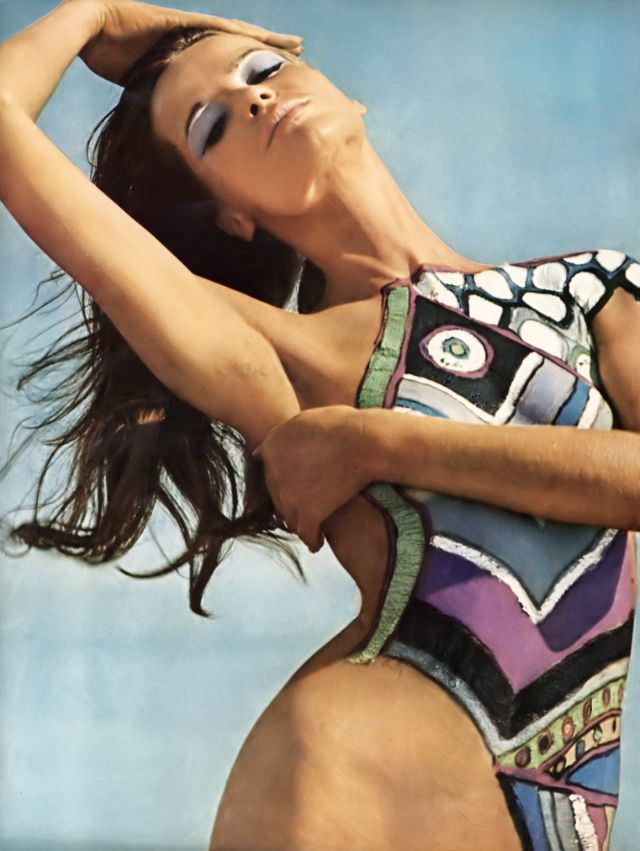
Reclining against a wash of open sky, Veruschka turns her face upward, eyes closed, as if letting the light do the styling. The pose is languid yet sculptural—one arm arched over her head, the other crossing her torso—creating long, clean lines that echo the graphic boldness of the design painted onto her body. Wind catches her dark hair, and the close crop heightens the sense of intimacy while keeping the setting intentionally spare.
Pucci-pattern body paint transforms fashion into pure surface and illusion, with crisp outlines and jewel-toned blocks of color mimicking a sleek, sleeveless garment. The painted motifs—curving bands, geometric panels, and high-contrast edging—read as both clothing and artwork, collapsing the boundary between textile and skin. Strong, stylized eye makeup reinforces the era’s mod glamour, while the matte, hand-rendered finish of the paint signals the deliberate artifice behind the effortless look.
Within the world of Vogue in 1966, this kind of image embodied a wider cultural shift toward experimentation, where editorial photography flirted with performance, design, and the avant-garde. The composition relies on negative space and a confident, elongated silhouette to sell the idea as much as the “outfit,” making it instantly searchable as 1960s fashion photography, Pucci-inspired styling, and iconic model imagery. What endures is the tension between freedom and precision: a body posed in the breeze, and a pattern controlled down to the last contour line.