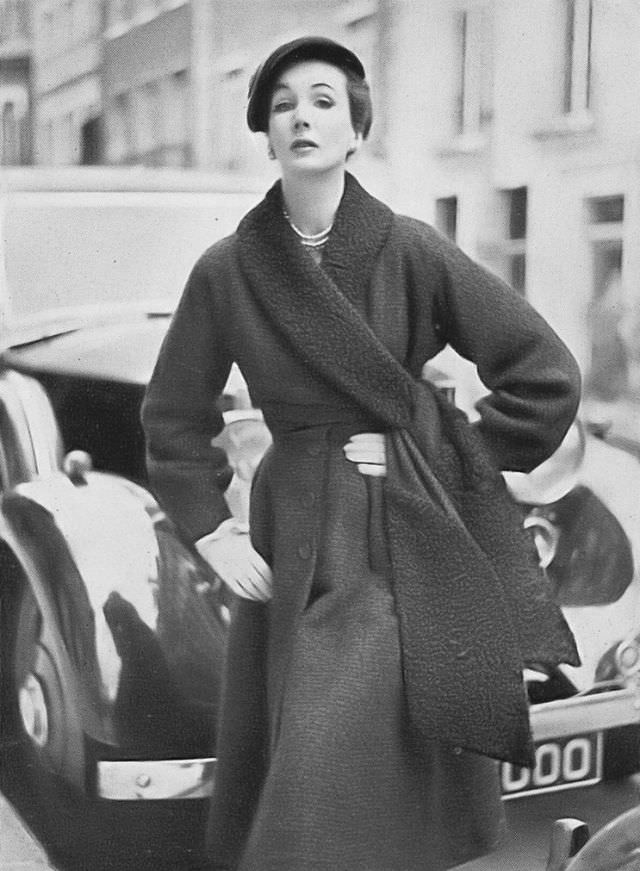
Poised against the curve of a parked car, Barbara Goalen projects the cool assurance that defined early-1950s British fashion photography. Her stance—one hand set at the waist, shoulders squared, chin slightly lifted—turns a quiet street into a runway, while the softly blurred buildings behind her keep attention on silhouette and attitude. The overall mood is metropolitan and self-possessed, echoing the era’s renewed appetite for elegance and modern city life.
At the center is a liquorice-colored ribbed bouclé coat by Digby Morton, its texture reading as plush and weighty even in monochrome. A generous collar frames the neckline, and a cross-over sash in black Persian lamb slices diagonally across the front, adding depth and contrast to the otherwise streamlined wrap shape. Topped with a sculptural hat by Rudolf and finished with a neat necklace, the look balances warmth, luxury, and crisp tailoring—hallmarks of high-end postwar outerwear.
Fashion historians often point to Goalen’s images as a bridge between couture display and the emerging idea of the “supermodel,” where personality sells the garment as much as cut and cloth. The composition—model, car, and street—plants the coat firmly in the world of aspirational everyday life rather than an abstract studio. For searches tied to 1952 style, Digby Morton designs, and mid-century British fashion culture, this photograph remains a vivid reference point for how glamour was worn outdoors, with confidence as its most essential accessory.