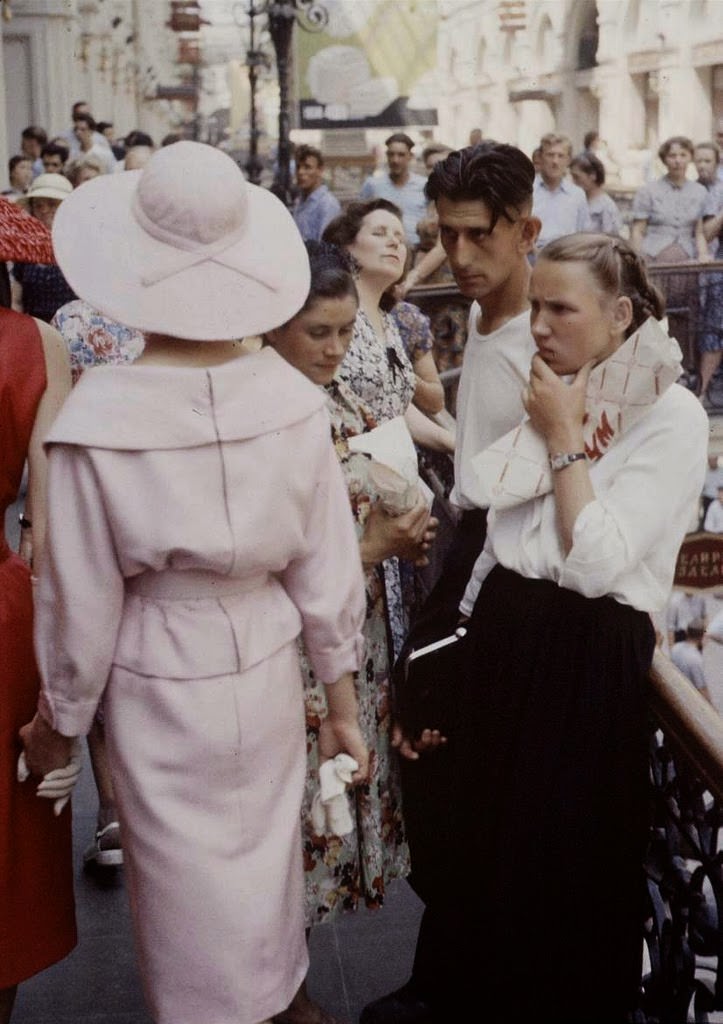
Pastel elegance moves through a crowded Moscow sidewalk, the wearer turned away from us in a fitted coat-dress and a wide-brim hat that reads unmistakably “couture” against the everyday bustle. Around her, faces tighten with curiosity—some amused, some skeptical, some simply stunned—as if the street itself has been interrupted by a runway moment. The contrast between soft tailoring and utilitarian surroundings makes the scene feel like a cultural jolt caught mid-step.
1959 sits in the background of this encounter as more than a date; it’s a mood of thaw and tension, when foreign style could appear briefly, brilliantly, and then vanish behind the routines of Soviet life. The onlookers’ body language—hands at chins, heads angled for a better look—suggests how clothing can become news, a public debate without a single banner. Even without a visible logo, the silhouette evokes the Dior mystique that the title promises: refined lines, deliberate structure, and a sense of privilege imported into a world that officially mistrusted it.
Fashion and culture meet here in the smallest details: the neat seams, the hat’s sculptural crown, the crowd pressed close enough to judge the fabric with their eyes. For readers searching the story of Dior in Moscow, Soviet street style, and the shock of Western couture behind the Iron Curtain, this photo offers something rarer than a catwalk shot—an unfiltered reaction. It’s a reminder that the most dramatic runway can be a city street, and the loudest commentary can be a silence shared by strangers watching one woman pass.