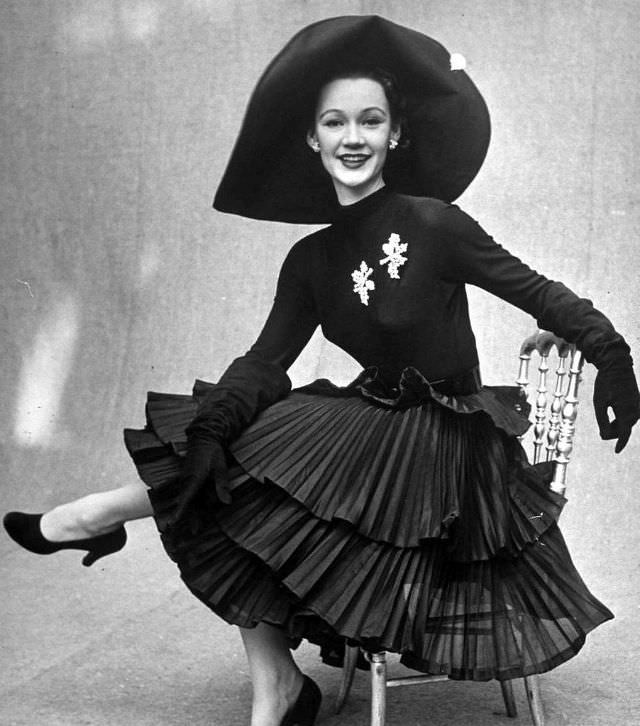
Sophie Malgat is posed with a buoyant, stage-ready ease, her smile bright beneath an oversized picture hat that frames her face like a halo of felt. The long-sleeved top reads sleek and sculptural in the studio lighting, punctuated by sparkling, floral-like appliqués at the chest that catch the eye against the dark fabric. Even in a simple backdrop, the styling carries the unmistakable drama of early-1950s couture fashion photography.
What steals the scene is the skirt: three tiers of crisp pleats that fan outward in a controlled burst of volume, emphasizing movement even as she sits. A ribboned waistband defines the silhouette, while gloves and neat pumps keep the look polished and formal. The chair’s slender lines and her lifted leg add a playful, almost dance-like gesture that shows how designers and editors of the period sold clothes through attitude as much as cut.
Dated February 1951 and credited to Jacques Fath, the ensemble speaks to a postwar appetite for elegance—bold shapes, meticulous construction, and a hint of theatricality suited to magazine pages. The photograph’s high-contrast monochrome heightens texture: the matte hat, the smooth bodice, and the rhythmic pleating stacked like architecture. As a snapshot of Fashion & Culture in the early 1950s, it preserves the moment when Parisian style balanced sophistication with showmanship, and a model’s pose could make couture feel alive.