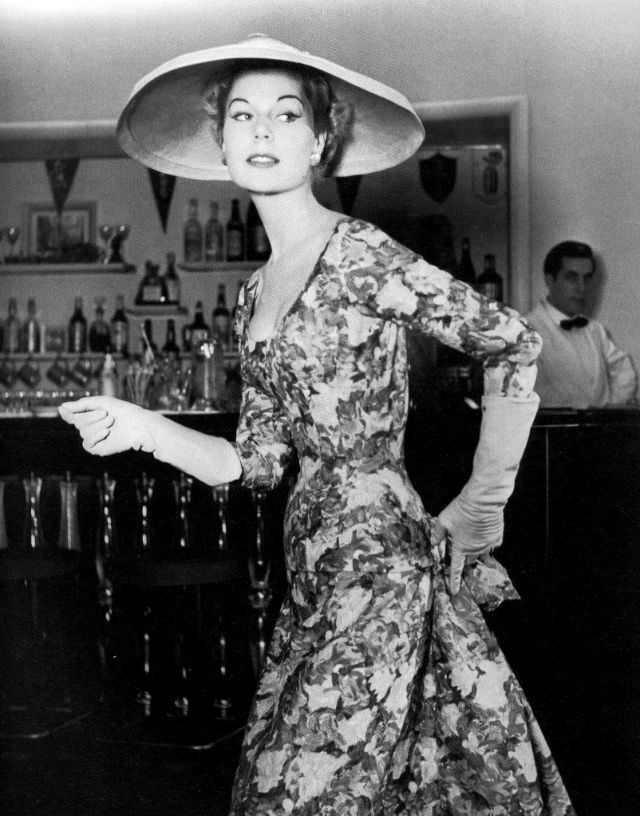
Stella turns slightly in profile, caught mid-gesture as if she has just crossed the room and paused to be noticed. A wide-brimmed hat frames her face and amplifies the elegant line of her neck, while long gloves and a poised hand at the hip underline the controlled drama of mid-century modeling. Behind her, a bar stocked with bottles and glassware gives the scene a lived-in glamour, the kind of nightlife setting where fashion and society routinely intersected.
The printed silk dress by Jacques Fath reads as a statement of 1955 couture sensibility: fitted through the bodice, sculpted at the waist, and released into a full, movement-friendly skirt. Its dense floral pattern and tailored structure balance softness with precision, making the fabric look luxurious even in monochrome. The styling—hat, gloves, and carefully arranged posture—suggests an era when accessorizing was part of the architecture of a look, not an afterthought.
Fashion photography of this period often thrived on contrast, and the image plays with it: a composed model in designer silk against the working backdrop of a bartender and the quiet clutter of a busy room. Rather than a sterile studio, the setting lends narrative texture, hinting at the social world that couture was meant to inhabit. Seen through that lens, Stella’s moment becomes more than a pose—it’s a small portrait of 1950s fashion culture, where elegance was performed with confidence and craft.