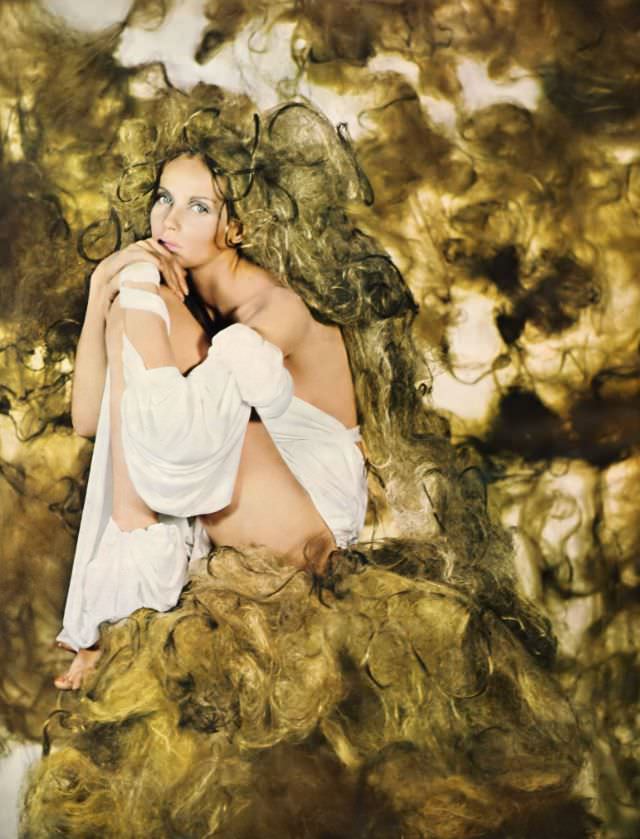
A pale, statuesque figure sits curled inward against a haze of olive and gold, her gaze held steady as if meeting the reader in a quiet dare. The styling is all contrast: soft white fabric draped across the body, bands of light on the arm, and a dramatic halo of swirling synthetic hair—Dynel—spilling outward like smoke or seaweed. That sculptural mass turns the portrait into something between fashion spread and modern myth, with texture doing as much storytelling as pose.
Veruschka’s presence in late-1960s Vogue often leaned into the uncanny, and the title’s nod to Sant’ Angelo places the look firmly in the era’s experiment-driven couture and ready-to-wear dialogue. The composition flattens space so the background becomes an abstract field, letting the hair’s wiry curls and the garment’s clean whiteness read as pure graphic design. Subtle color tinting and controlled light heighten the editorial mood, emphasizing the period’s appetite for art-photography sensibilities within mainstream fashion magazines.
Seen today, the image works as a capsule of 1968 fashion culture: synthetic materials elevated to fantasy, the model as icon rather than mere mannequin, and Vogue’s editorial pages pushing beyond straightforward elegance. The “a-swirl” hair is the headline, yet the emotional pull comes from the stillness of the sitter amid that turbulent texture, a poised enigma framed by manufactured fibers. It’s a memorable example of how 1960s fashion photography could transform clothing and styling into atmosphere, idea, and attitude all at once.