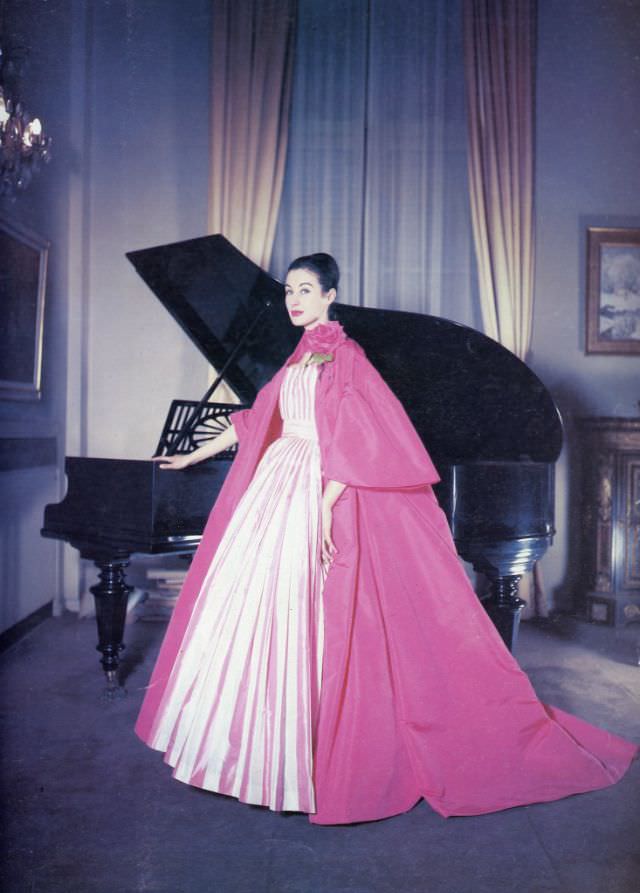
Under soft interior lighting, a model stands beside a grand piano, her hand resting lightly on its polished edge as if pausing between notes. The setting—tall draped curtains, framed wall art, and the piano’s open lid—creates a salon-like atmosphere that suits the title “Nuit à Trianon,” suggesting an evening of cultivated glamour rather than a crowded runway.
Balmain’s 1959 evening gown pairs a luminous, vertically striped skirt with an enveloping cape in a saturated rose-pink tone, the fabric falling in generous, sculptural folds. The silhouette reads as classic mid-century couture: a cinched waist, full skirt, and an outer layer that moves like a theatrical curtain, emphasizing ceremony and presence. Details like the high, sleek hairstyle and poised posture underline the era’s polished elegance and the house’s reputation for refined, aristocratic drama.
Color photography lends the design an added sense of immediacy, preserving the contrast between the bright dress and the bold cape with a richness that black-and-white often flattens. For fashion history and 1950s couture enthusiasts, the image works as both document and mood piece, placing Pierre Balmain’s craftsmanship within the broader story of postwar luxury, society dressing, and the cultural staging of haute couture. Keywords such as Pierre Balmain, 1959 evening gown, Nuit à Trianon, 1950s fashion, and French couture fit naturally here, reflecting the enduring appeal of this glamorous period style.