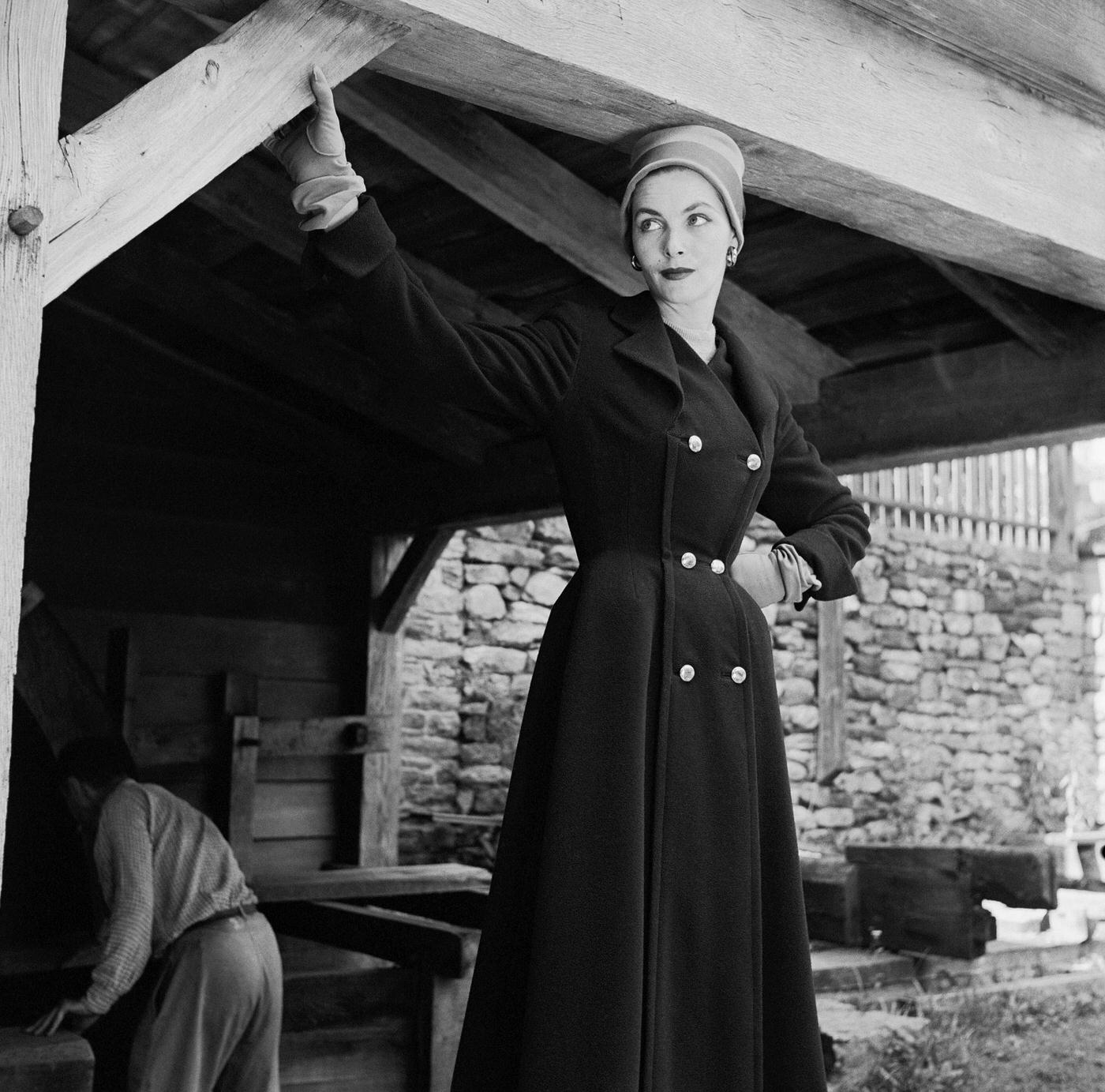
Under the heavy timber beams of a barn at Philipes Manor Hall, Georgia Hamilton strikes a poised, sculptural stance that turns a working space into an impromptu runway. Her raised arm meets the rough wood overhead, while her gaze angles outward with the calm assurance of a seasoned fashion model. The contrast between refined styling and utilitarian architecture gives the scene its charge, framing glamour against an honest, rural backdrop.
The wool coat suit by Seymore Fox reads as both practical and polished, tailored with a strong, fitted waist and a long, sweeping skirt that moves like a curtain of dark fabric. Double-breasted buttons catch the light, and coordinated accessories—gloves, earrings, and a close-fitting hat—underscore the era’s preference for complete, composed ensembles. Even in monochrome, the outfit’s textures and lines stand out crisply against the barn’s weathered boards and stonework.
Behind Hamilton, the setting stays deliberately un-romantic: a stone wall, wooden partitions, and the dim interior recesses of the structure, with a figure bent to work at the far left edge. That small glimpse of labor beside high fashion creates a quiet narrative about class, place, and performance, making the photograph more than a simple style portrait. As a piece of fashion history and cultural storytelling, it offers a memorable look at how designers and photographers sought drama by staging elegance where it least “belongs.”