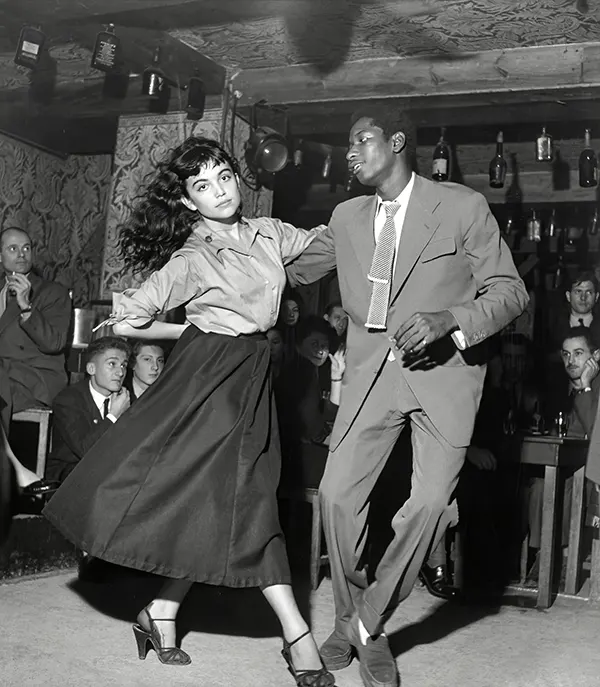
Under the low ceiling of a “Be Bop” theater, a young couple commands the floor with the quick, elastic energy of 1950s social dancing. The woman’s full, mid-calf skirt swings outward as she pivots, her blouse neatly tucked and her hair caught in motion, while her partner guides the step in a sharply tailored suit and tie. Their pose holds the perfect balance of spontaneity and polish—street-smart rhythm dressed up for a night out.
Around them, the audience forms a tight ring of attention, seated at small tables and leaning forward to watch the performance unfold. Faces turn from every corner, some intent and serious, others quietly amused, as if measuring each turn and footfall against the music they hear but we cannot. Bottles lined along the back wall and the textured décor suggest a lively, intimate venue where entertainment and everyday life mingle.
Fashion and culture meet here in one kinetic scene: menswear cut clean and confident, womenswear built for movement, and a dance style that celebrates individuality within the rules of partner work. The photo’s appeal lies in its immediacy—the blur of a skirt, the angle of a shoulder, the charged space between two bodies moving in time. For anyone searching the history of 1950s nightlife, bebop dance culture, or mid-century style icons, this moment distills the era’s glamour into a single, unforgettable step.