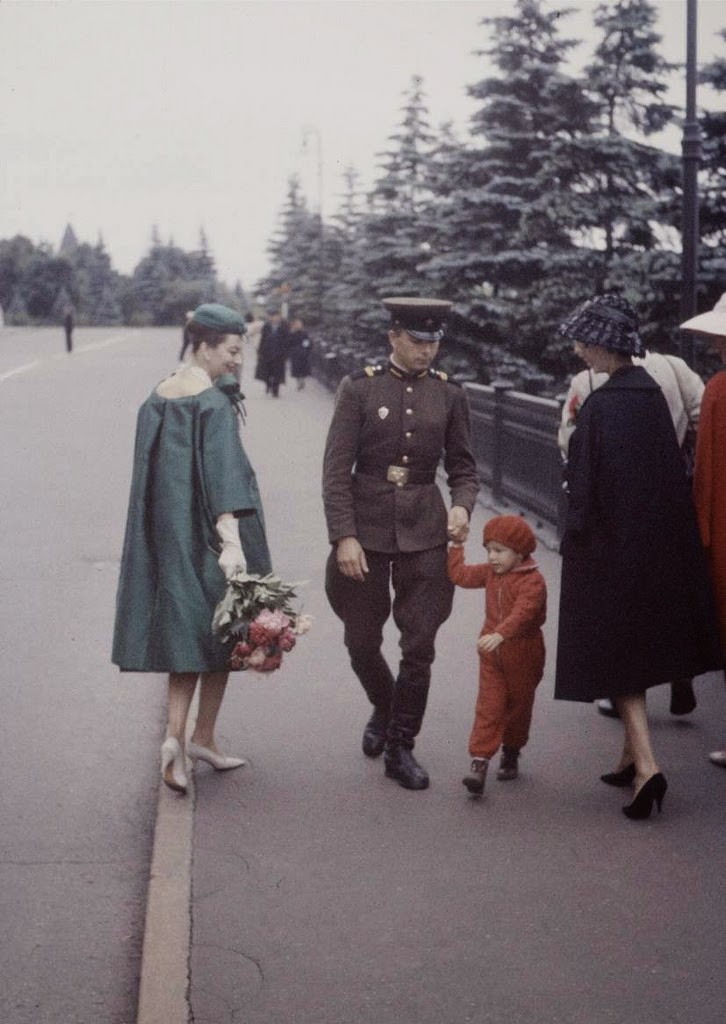
Silk-green elegance meets everyday Moscow in this candid street scene, where a sharply dressed woman pauses with a bouquet in hand as passersby stream along the wide pavement. Nearby, a uniformed man walks with a small child in a bright red outfit, while women in dark coats and patterned headscarves look on—an ordinary moment that still reads like a cultural crossroads. The contrast between tailored Western glamour and practical Soviet streetwear is the photo’s quiet drama, made even sharper by the soft color palette and the formal posture of the figures.
1959 is often remembered for a sudden jolt of international style in the USSR, and the title’s “Dior takeover” points to the sensation created when French haute couture entered public view. Beyond the runway, fashion became a conversation in motion: hem lengths, gloves, hats, and heels turned into signals of aspiration, curiosity, and modernity. In a society where clothing was expected to be functional and ideologically modest, couture’s theatrical polish could feel like a shock—both alluring and suspicious at once.
What makes this historical photo so compelling is how it frames fashion history as lived experience, not simply as a headline event. Trees, lampposts, and the long receding walkway create a stage where diplomacy, spectacle, and daily routines overlap, reminding us that the Cold War was also fought with images and silhouettes. For readers interested in Dior in Moscow, Soviet street style, and 1950s fashion culture, the scene offers a rare glimpse of how global trends filtered into public space—one glance, one bouquet, one step at a time.