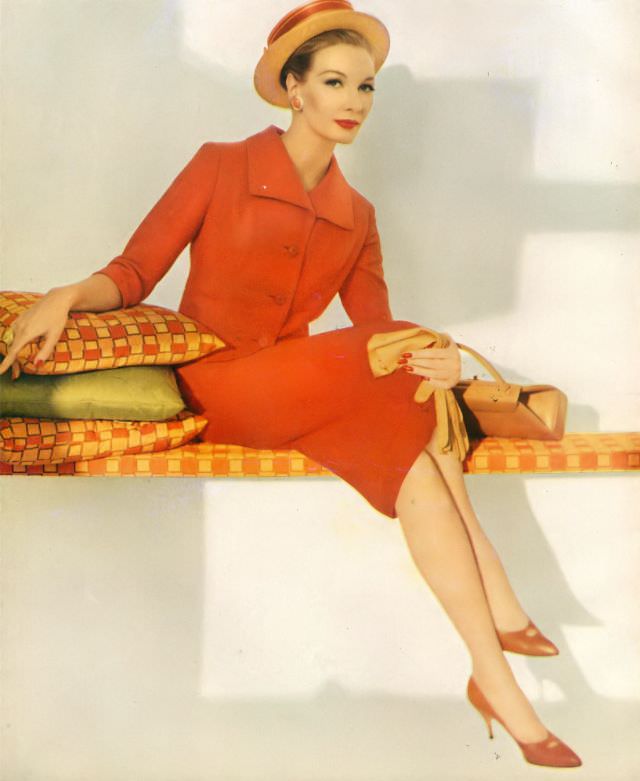
Poised on a patterned bench, Jessica Ford models a salmon-colored wool tweed suit by Handmacher with the quiet confidence that defined late-1950s fashion photography. The tailored jacket—neat collar, covered buttons, and a clean, structured line—pairs with a slim skirt that emphasizes a polished, city-ready silhouette. Her red lipstick and carefully styled hair underline the era’s emphasis on immaculate grooming, while the color image itself lends a vivid, boutique-window immediacy.
Accessories do much of the storytelling here: a straw hat with a warm band frames her face, while gloves and a small handbag signal ladylike practicality as much as glamour. Coordinated heels echo the suit’s tonal harmony, and the crisp studio backdrop keeps attention fixed on texture, fit, and color. Even the stacked cushions—graphic, mid-century patterns in complementary shades—feel chosen to make the tweed and salmon hue look richer and more modern.
Fashion historians often read images like this as more than clothing documentation; they’re snapshots of aspiration and everyday elegance at the end of a decade obsessed with refinement. The Leombruno-Bodi style of commercial polish comes through in the careful pose, the controlled light, and the sense that every detail has been edited toward a single message: streamlined sophistication. As a 1959 fashion portrait, it’s an SEO-friendly window into mid-century womenswear, designer tailoring, and the culture of accessorized, put-together femininity.