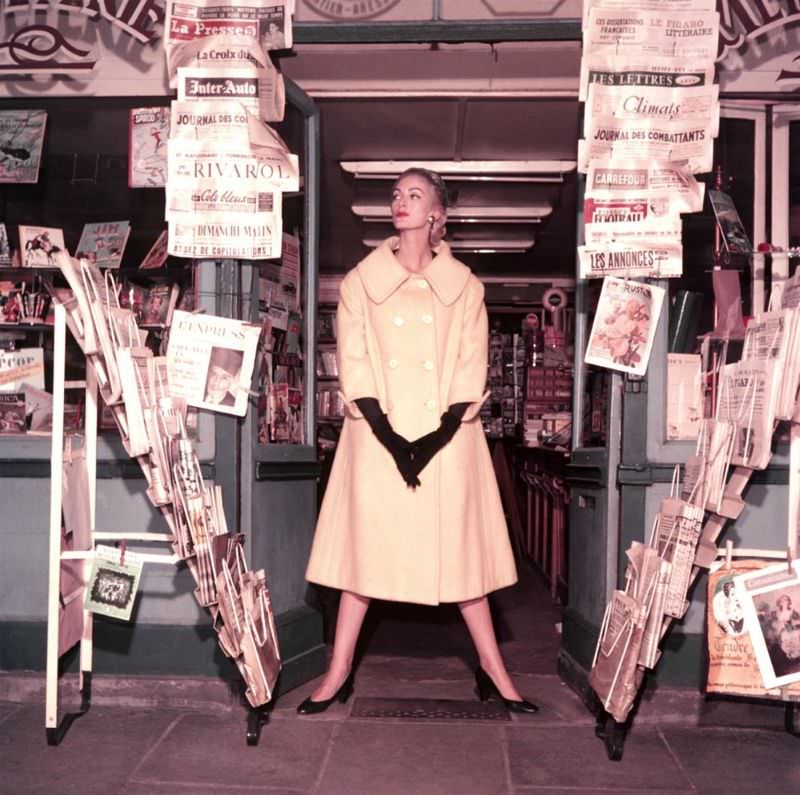
Outside a Paris bookshop in 1954, Carmen Dell’ Orefice stands framed by a crowded doorway of paper and print, poised like a living display between racks of newspapers and magazines. Posters and mastheads stack up on either side—dense with French headlines—turning the entrance into a collage of postwar reading culture. Her stance is deliberate and theatrical, legs set wide on the pavement as she gazes off to one side, lending the street scene the air of a fashion stage.
Jacques Fath’s coat, cut with a generous swing and an oversized collar, reads as pure mid-century elegance: sculptural, refined, and meant to be seen from a distance. The pale fabric catches the light softly, while dark gloves and sleek shoes sharpen the silhouette with graphic contrast. Even amid the busy storefront, the garment holds the center, suggesting how couture could command attention without excess ornament.
Georges Dambier’s photograph—titled “La Librairie”—thrives on this meeting of worlds: high fashion posed against the everyday commerce of books, journals, and news. The composition celebrates Paris as a capital of both style and ideas, where a model can appear at home in the rhythm of the street. For viewers searching for 1950s Paris fashion photography, couture history, or the cultural mood of the era, the image remains a vivid reminder that elegance often borrowed its power from ordinary urban life.