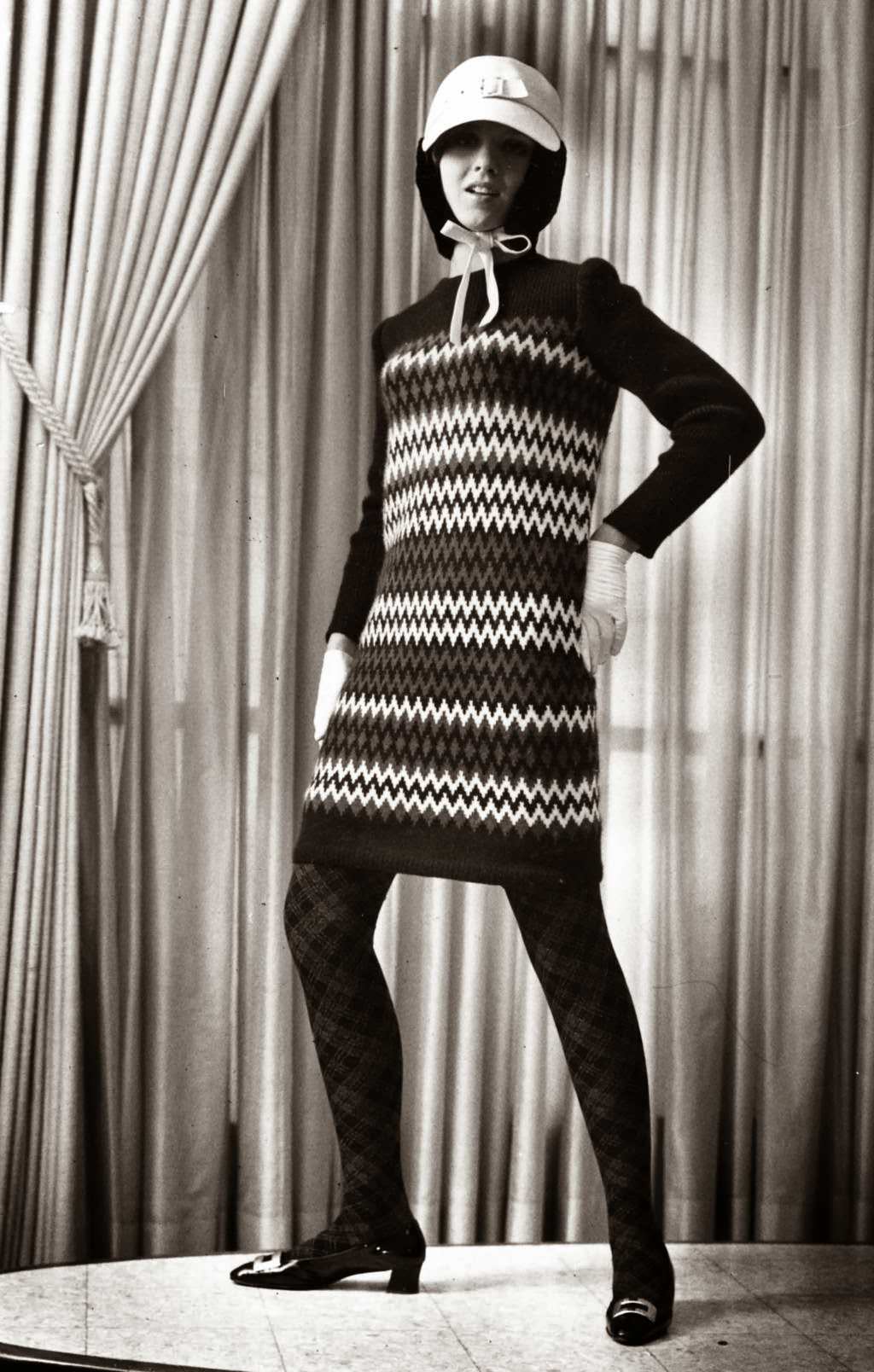
A poised young model stands before gathered curtains, one hand on her hip, as a graphic sweater dress turns the body into a bold pattern of zigzags. Even in monochrome, the design reads as high-contrast and rhythmic, underscoring why Yves St. Laurent’s “total look” felt so modern in the mid-1960s. The short hemline and clean silhouette echo the era’s growing appetite for youth-driven fashion that moved confidently beyond tradition.
Details do the storytelling here: the argyle wool stockings add a second layer of geometry, while chunky-heeled patent shoes ground the look with a practical, streetwise edge. A white leather cap fastens under the chin and frames the face with a dark snood, its buckle catching the light like a small piece of hardware in an otherwise soft, knit-focused ensemble. The overall effect is coordinated yet daring—an outfit conceived as one complete statement rather than a collection of separate pieces.
Seen through the lens of a Tribune archive photo dated Sept. 10, 1966, the styling becomes a snapshot of how couture ideas filtered into wider fashion culture. The title’s red, white, and blue scheme speaks to color-block confidence, while the staging and pose emphasize movement, youth, and attitude—the same ingredients that helped make the miniskirt a lasting symbol of 1960s style. Readers drawn to vintage fashion photography, Yves St. Laurent history, and 1960s mod dressing will find a compact lesson in how a single look could define a moment.