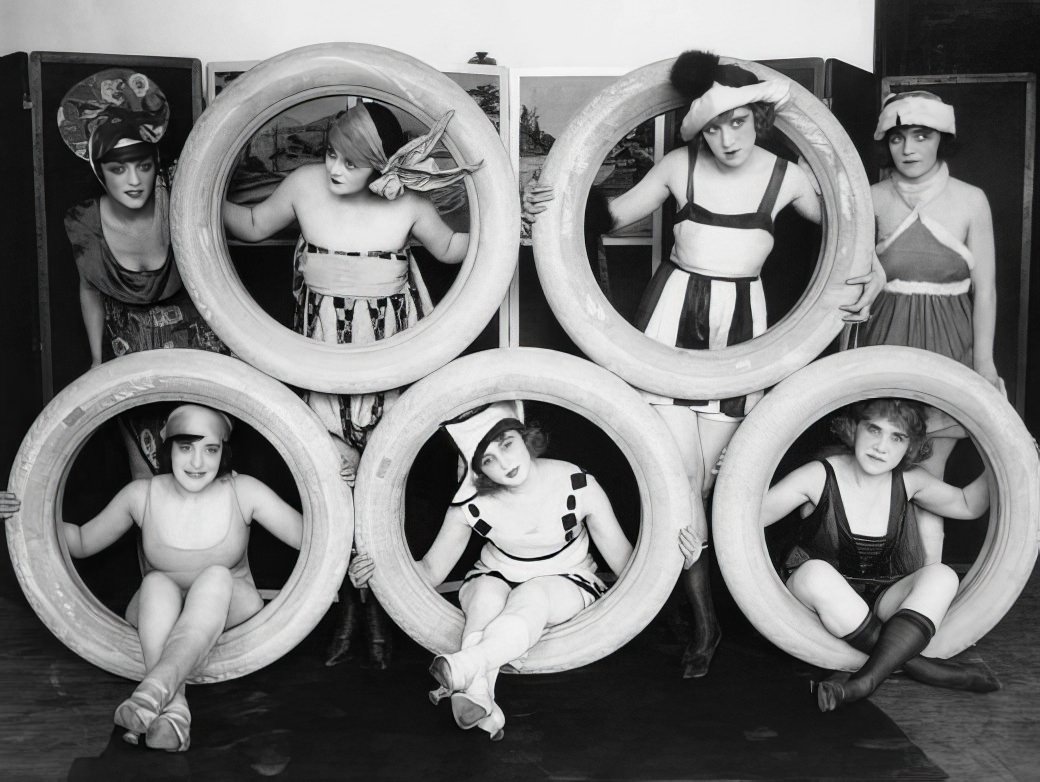
A playful lineup of young women poses with oversized inner tubes, their faces framed like portraits and their bodies arranged in a neat, stagey grid. The bathing costumes—striped or dark, with modest hems and sturdy straps—read as unmistakably 1910s, while soft caps and headwraps signal the era’s practical approach to swimwear. Painted screens in the background hint at a studio setting, where “beach” fun could be manufactured under controlled lights for the camera.
Known through the title as the Sennett Bathing Beauties, this kind of image reflects how early Hollywood packaged leisure, beauty, and comedy into a single marketable spectacle. The inner tubes function as both prop and punchline, turning athletic seaside equipment into a graphic design element that spotlights legs, posture, and expression without resorting to overt exposure. Poised between innocence and modern allure, the women project a new kind of on-screen glamour—cheerful, recognizable, and ready-made for publicity.
For fashion and culture historians, the photograph offers a snapshot of shifting attitudes in 1915: public recreation expands, women’s silhouettes simplify, and the idea of the “movie star look” begins to circulate beyond the theater. Details like the knit texture of the suits, the dark stockings, and the carefully styled bobbed or pinned hair show how modesty and modernity coexisted in early swim fashion. As a piece of silent-era Hollywood promotion, it also reveals the mechanics of image-making—how choreography, costume, and a few inflatable rings could sell an aspirational lifestyle to a rapidly growing mass audience.