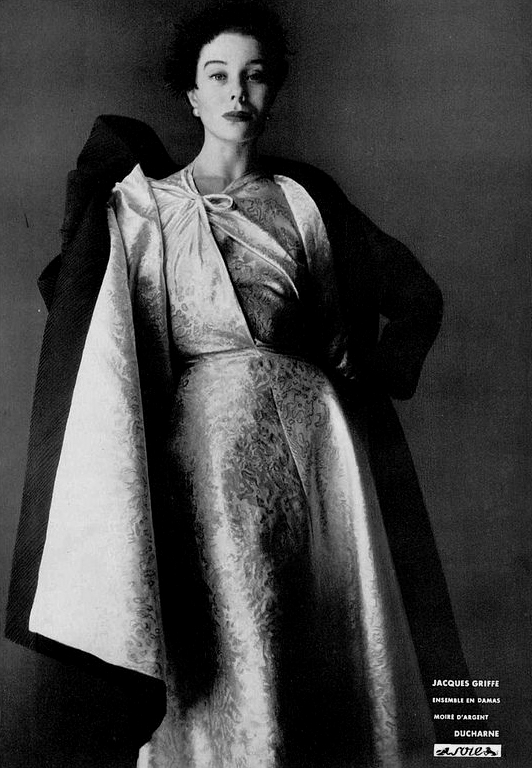
Bettina Graziani stands with a poised, self-assured stillness, her gaze lifted toward the camera as if meeting the viewer on equal terms. The styling is pared back to essentials—a plain studio backdrop, sculptural lighting, and a strong, upright stance—so the drama comes from silhouette and attitude rather than setting. Dark hair frames her face, and the overall mood feels both intimate and commanding, a hallmark of mid-century fashion photography.
Jacques Griffe’s design takes center stage in a shimmering damask ensemble that reads as “silver-black” in the photo’s tonal range, catching light across its patterned surface. A bow at the neckline softens the look, while the fabric’s sheen and the clean, fitted lines emphasize couture craftsmanship and the postwar fascination with luxury textiles. Draped around her shoulders, a darker outer layer creates a bold contrast, sharpening the garment’s contours and lending the portrait a graphic, almost architectural quality.
In 1953, images like this helped define the growing power of the fashion model as more than a mannequin—Bettina appears as a personality, projecting elegance and modernity in a single frame. The minimal composition makes it a highly searchable example of 1950s French couture, Jacques Griffe fashion, and classic studio portraiture, where texture, cut, and confidence do the storytelling. Even without a bustling runway or ornate interior, the photograph communicates the era’s glamour through restraint, precision, and impeccable styling.