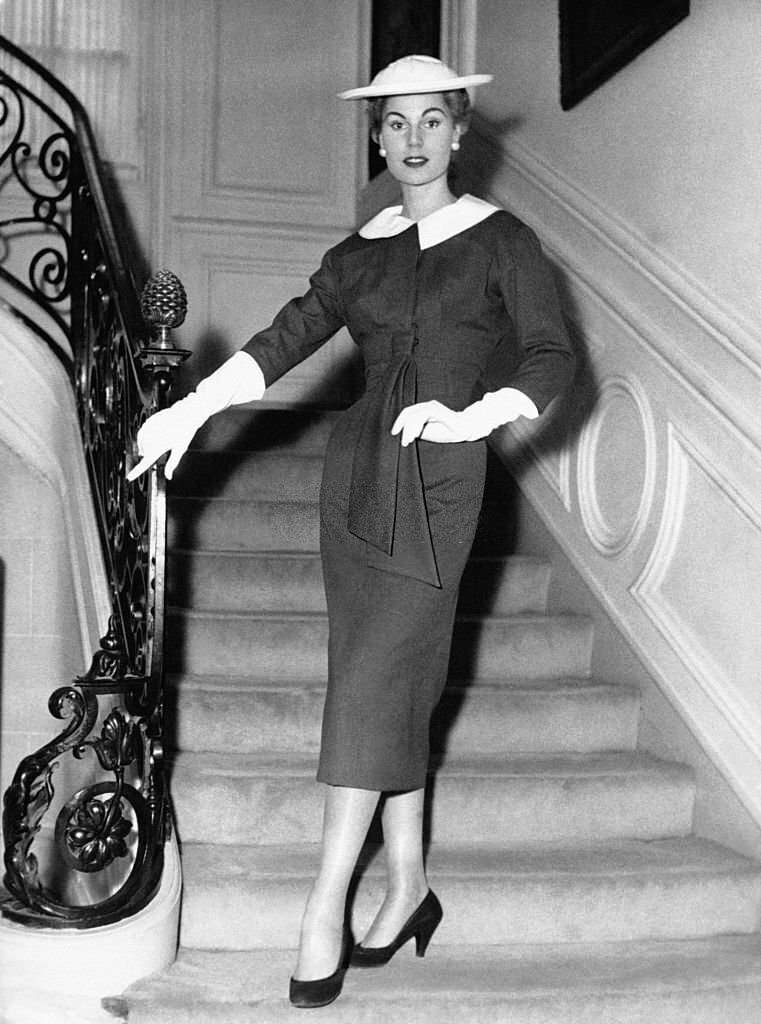
Poised on a sweeping staircase, a model presents a refined blue wool afternoon dress from a Paris summer collection, dated February 26, 1949. The tailored silhouette falls in a clean, narrow line to mid-calf, emphasizing the era’s taste for disciplined elegance after the war years. A crisp white collar frames the neckline, echoing the polished restraint that defined high-fashion daywear in late-1940s France.
White gloves extend past the wrists and sharpen every gesture, turning her relaxed stance into a studied performance of grace. The wide-brim hat sits lightly atop carefully styled hair, balancing the dark dress with a bright, graphic accent; classic pumps complete the ensemble with understated authority. Even in monochrome, the contrast between deep fabric and pale accessories makes the look read instantly as couture—precise, expensive, and meant to be noticed.
Behind her, the ornate iron banister and paneled walls suggest the intimate luxury of a salon setting, where Parisian fashion was often staged like theater. The composition favors vertical lines—stairs, skirt, posture—so the viewer’s eye travels upward from hem to collar to hat, absorbing the outfit as a unified statement. As a slice of 1949 fashion and culture, the photograph captures the city’s enduring role in setting standards for women’s afternoon dress, accessories, and the choreography of style.