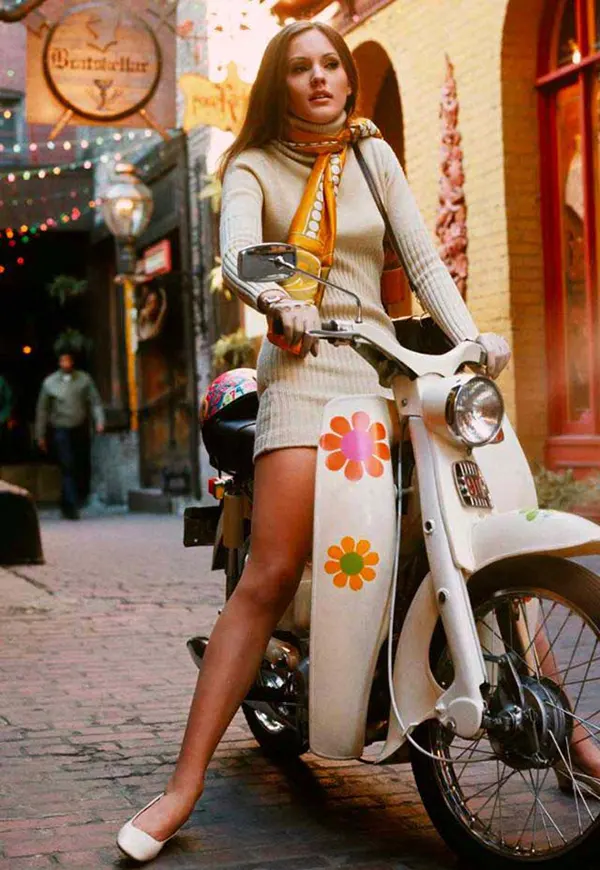
Leaning into the handlebars of a small white scooter, a young woman turns an ordinary street into a runway, her pose relaxed yet purposeful. The scooter’s front panel is decorated with bold flower decals in bright, pop-art colors, an instantly recognizable late-1960s motif that signals youthful optimism and playful design. Around her, a narrow cobblestone lane and shopfronts frame the scene, with hanging lights and signage hinting at a lively pedestrian quarter just beyond the camera’s focus.
Her outfit anchors the title “A scooter girl, 1969” in the era’s fashion language: a ribbed, long-sleeved mini dress that skims the thigh, paired with a patterned neck scarf tied neatly at the collar. Soft, coordinated tones and clean lines give the look a polished, mod-adjacent elegance, while simple flats keep it practical for city movement. Long, center-parted hair and minimal accessories let the clothing—and the scooter itself—carry the statement, blending chic styling with everyday mobility.
What lingers is the way fashion and transport merge into one cultural snapshot, capturing the late-1960s appetite for freedom, individuality, and modern urban life. The scooter reads as more than a vehicle; it’s a lifestyle prop that links street style, youth culture, and the changing rhythms of the city. For anyone searching for 1969 fashion, vintage scooter style, or iconic 1960s street photography, the image offers a vivid reminder of how glamour could appear in motion, right at curb level.