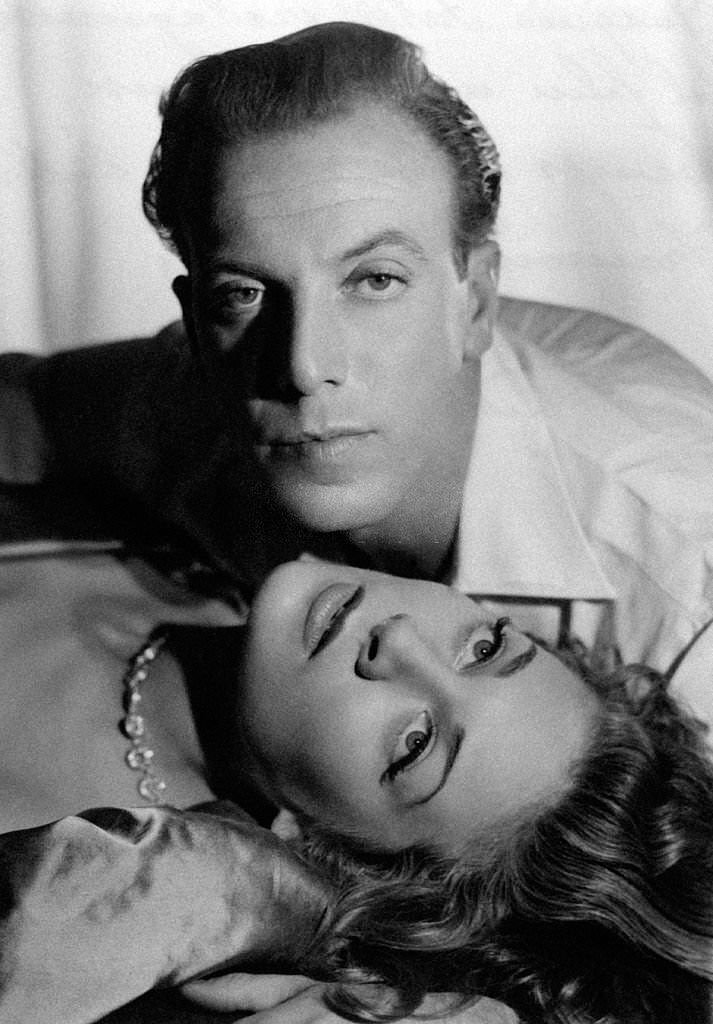
Leaned in close to the lens, Jacques Fath holds a steady, almost appraising gaze, his face lit in smooth gradations that emphasize cheekbones and the neatly groomed sweep of hair. In the foreground, Françoise Christophe reclines with practiced ease, her head tilted back to meet the viewer, lashes and brows sharply defined against the soft focus around her. The composition layers their faces diagonally, turning a quiet pose into a charged cinematic moment that feels both intimate and staged.
Released in 1949, *Scandale aux Champs-Elysées* is evoked here not through sets or signage but through the language of screen glamour: controlled light, polished expressions, and a closeness that suggests romance and intrigue. Fath’s presence carries the extra frisson of a couture figure stepping into film, where style and performance mingle effortlessly. Christophe’s coiffed waves and luminous makeup anchor the scene in postwar French elegance, a period when fashion imagery and movie publicity often borrowed from one another to sell the dream.
Even without lavish costumes on display, the photograph works as a piece of fashion-and-culture history, hinting at how designers, actors, and photographers collaborated to define an era’s look. The crisp white shirt, the glint of jewelry at the neckline, and the careful arrangement of bodies speak to mid-century taste for sophistication with a touch of scandal. For modern viewers searching for French cinema, Champs-Élysées allure, or Jacques Fath’s broader legacy, this still distills 1940s Parisian glamour into one unforgettable frame.