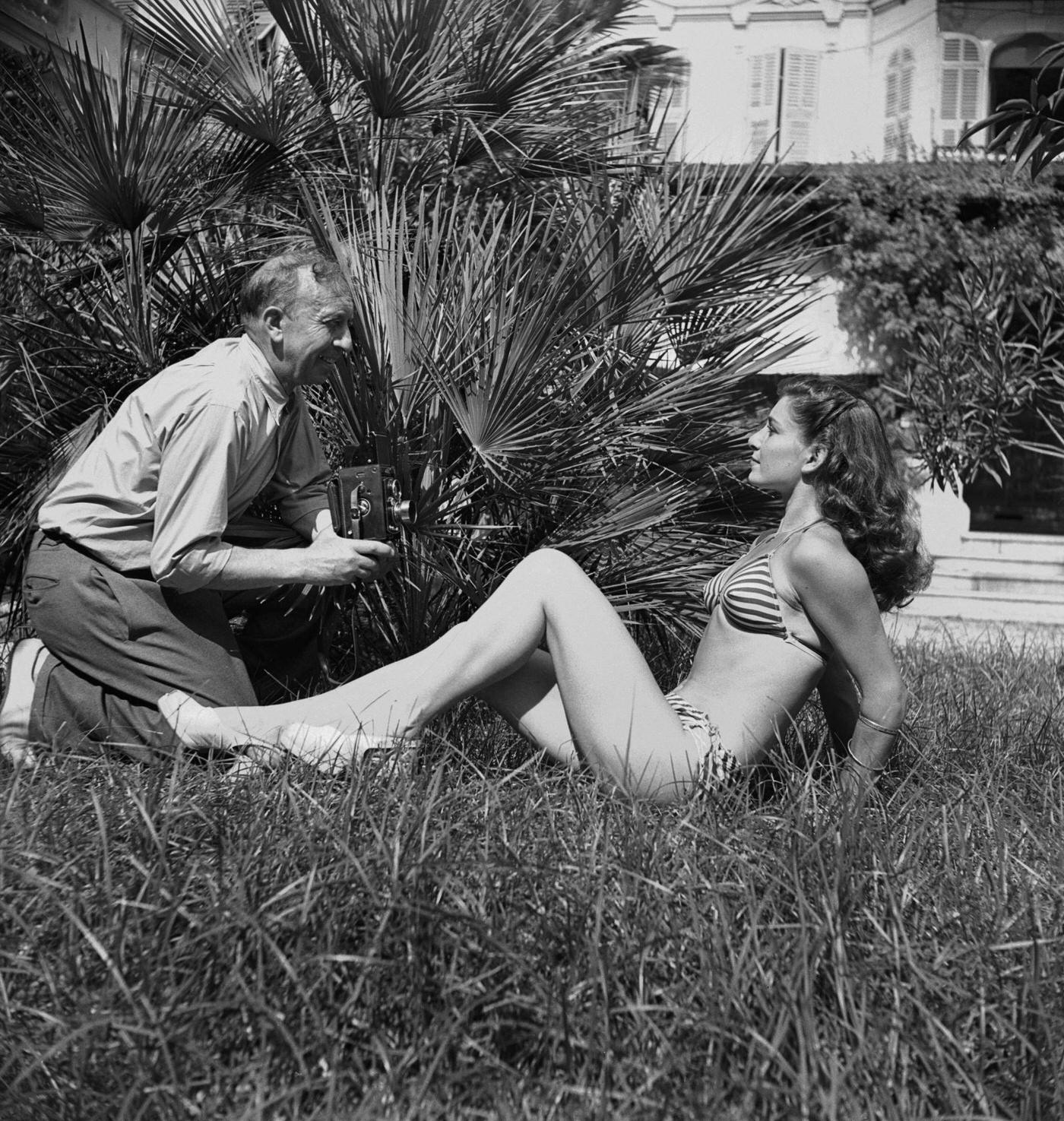
Leaning in with a boxy camera cradled in both hands, Boris Roger Viollet frames Annie Rouvre as she reclines on sunlit grass, the exchange between photographer and model caught in a candid, mid-session pause. Palm fronds flare behind them like a stage backdrop, while a bright façade with shuttered windows hints at the Riviera’s resort architecture. Rouvre’s striped two-piece swimsuit—structured at the bust and neatly cut at the hips—anchors the scene in the bold swimwear aesthetics of the late 1940s.
Set during the Festival of Cannes in September 1947, the photograph sidesteps the red-carpet spectacle for something more intimate: the making of an image, outdoors, in full daylight. Viollet’s posture and intent gaze suggest a professional eye searching for the right angle, while Rouvre’s relaxed pose and lifted chin project the poised confidence associated with postwar glamour. The surrounding greenery and open lawn evoke the leisure culture that Cannes was rapidly reclaiming, where cinema, tourism, and fashion fed one another.
Fashion historians often point to this era as a turning point, and the swimsuit here reads like a bridge between modest interwar styles and the more daring silhouettes soon to dominate beach photography. The crisp contrast of black-and-white film emphasizes texture—the ribbed stripes, the sheen of skin, the rough grass underfoot—making the image useful for anyone researching 1940s swimwear, French festival culture, or mid-century photography at Cannes. Even without the formal trappings of premieres, the picture carries the festival’s defining promise: modern celebrity, modern style, and the camera always close at hand.