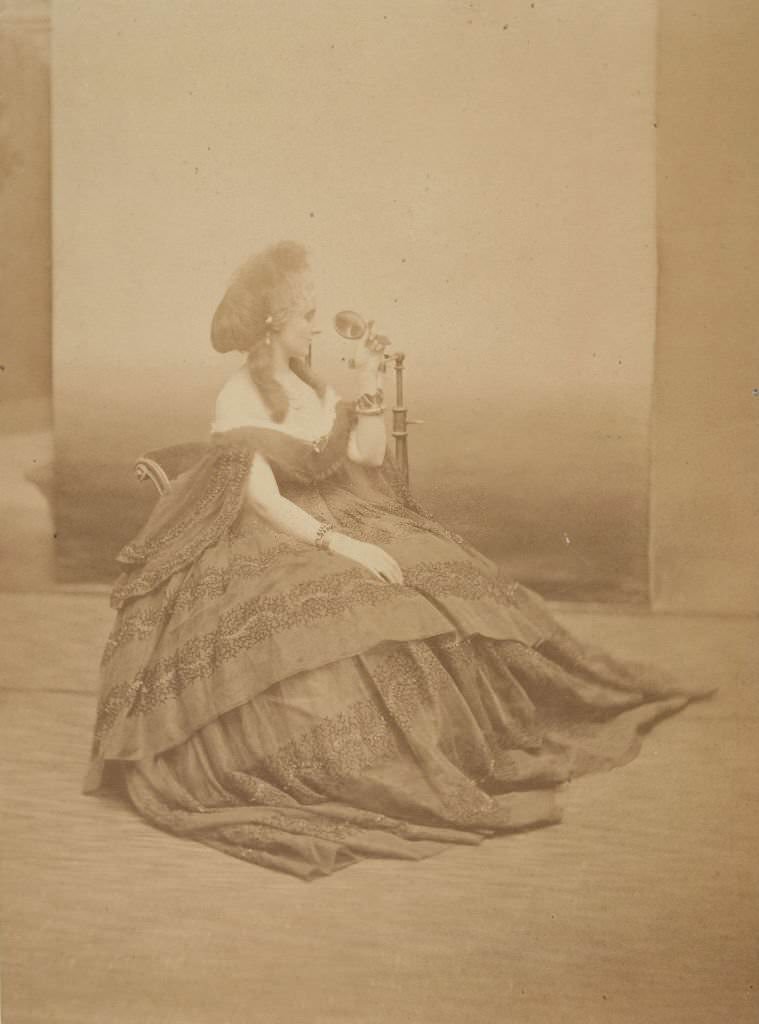
Soft studio light falls across a seated woman in full mid-19th-century dress, her crinoline-supported skirt spreading in generous folds across the floor. The gown’s dark fabric is richly patterned, with layered drapery and a long train that emphasizes the era’s taste for volume and theatrical silhouette. A small bonnet or cap frames her hair, completing a look that reads as carefully composed for the camera.
Beside her stands a tall, adjustable apparatus topped with a round lens or mirror-like disc, and she turns toward it in profile as if consulting her own reflection. The post title, “Mir s eyes, 1860s,” invites a playful reading of this encounter between face and glass: an early meditation on seeing and being seen, staged within the new culture of photography. Even in a quiet pose, the scene suggests Victorian curiosity about optics, self-presentation, and modern devices.
Crinolines were more than a fashion trend; they shaped posture, movement, and the very space a woman occupied, and the photograph makes that spatial drama unmistakable. The plain backdrop and bare studio floor keep attention on texture—brocade, sheen, and shadow—turning clothing into the main subject of the portrait. As an artifact of 1860s fashion and culture, the image offers a vivid glimpse into how style, technology, and identity could meet in a single carefully arranged moment.