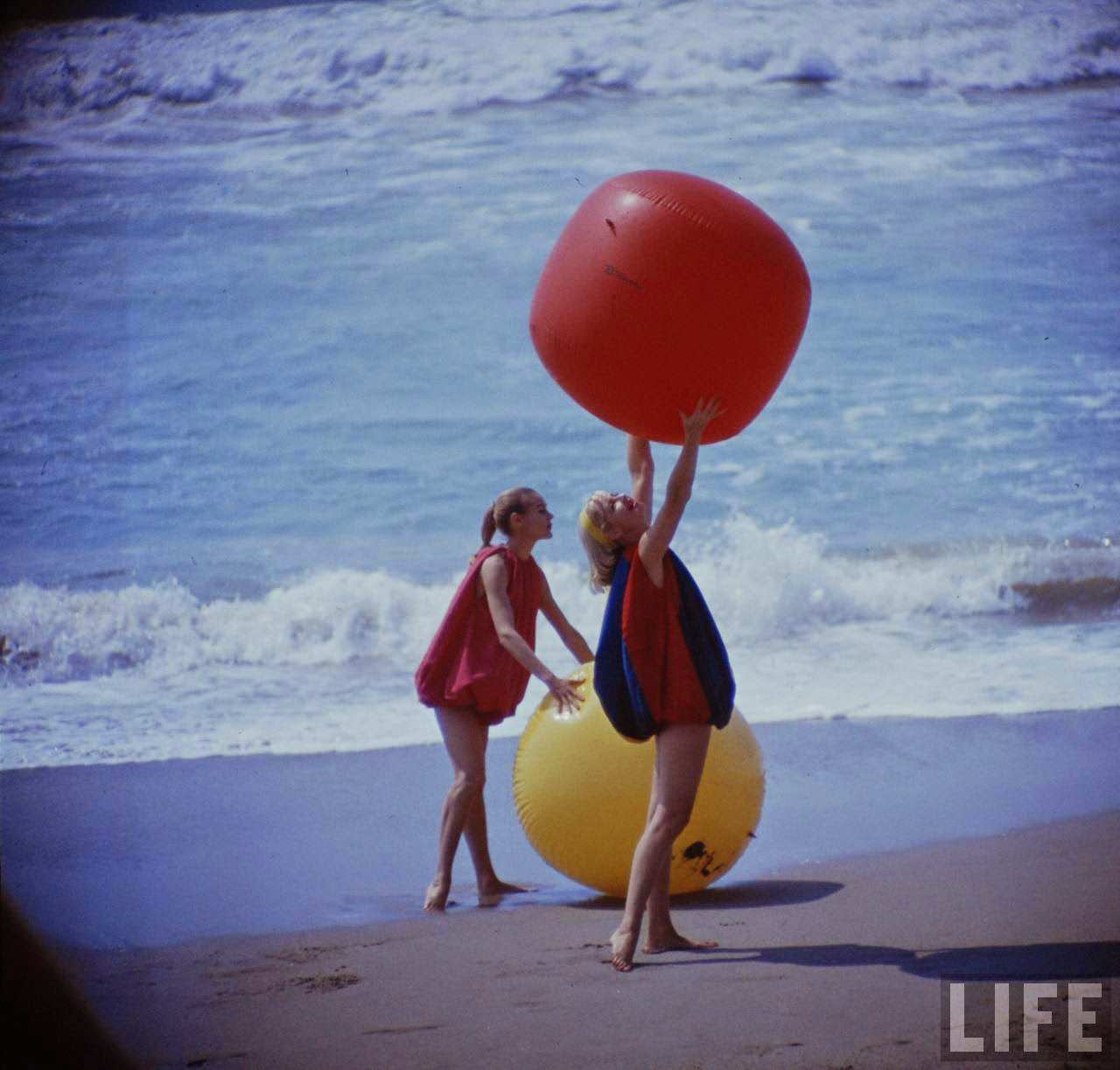
Salt air and surf frame two swimsuit models as they play with oversized beach balls on a Cuban shoreline, their silhouettes set against rolling waves. One woman reaches up to steady a glossy red sphere that nearly eclipses her head and shoulders, while a bright yellow ball rests at their feet like a prop from a modernist set. The saturated color palette—sea blues, sunlit sand, and bold primary tones—gives the scene the lively, mid-century look associated with magazine fashion photography.
Rather than a stiff runway pose, the moment feels candid and kinetic: bare feet planted in wet sand, bodies angled toward one another, attention fixed on the floating prop as if the ocean breeze might carry it away. The sculptural swimsuits read as period-appropriate resortwear, designed to be seen from a distance and photographed for print, with capelike drapes that catch the light and suggest movement. Even the foamy break of the water behind them becomes part of the composition, lending rhythm and scale.
In the context of 1950s Cuba, images like this helped sell an idea of tropical glamour—sun, leisure, and stylish escape—while also documenting the era’s visual language of fashion and travel culture. Credited to Gordon Parks in the title, the photograph aligns with the editorial sensibility of LIFE magazine, where lifestyle, design, and place were often blended into a single persuasive narrative. As a piece of fashion history, it preserves how mid-century swimwear and beach iconography were staged: playful, polished, and unmistakably of its time.