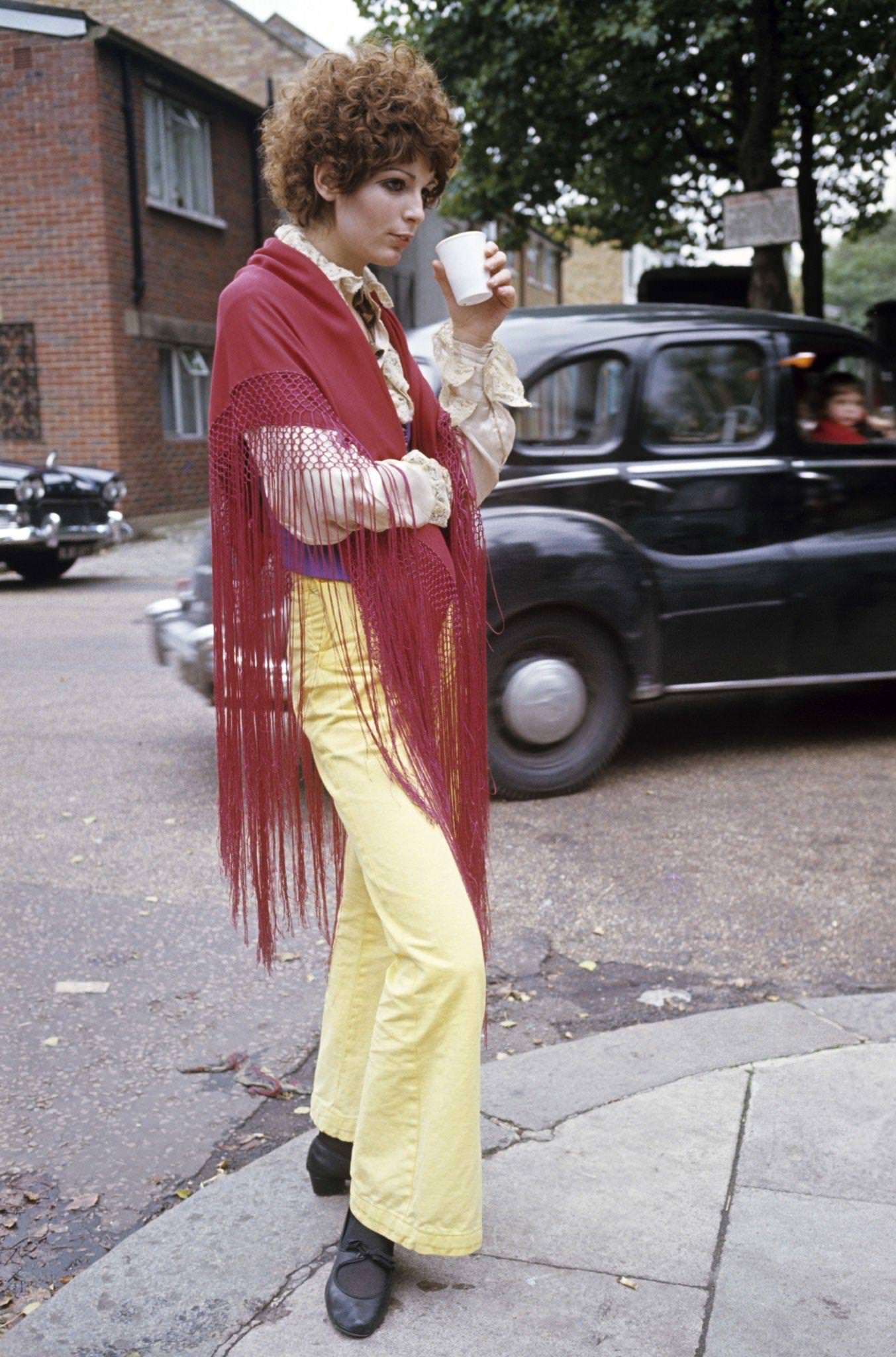
Leaning into the street’s everyday bustle, a young woman pauses on a pavement corner with a paper cup lifted to her lips, her expression thoughtful and unhurried. A deep red, fringed shawl drapes over a ruffled blouse, the long tassels falling in a curtain that exaggerates movement even in stillness. Pale yellow trousers and practical dark shoes complete a look that reads as distinctly late-1960s bohemian—soft, romantic layers set against the blunt geometry of the city.
Behind her, traffic and brick buildings place this moment firmly in urban Britain, with a dark taxi gliding past and older cars parked along the curb. The background is slightly blurred with motion, yet the subject’s styling remains crisp and tactile: crocheted texture, fluttering cuffs, and the dramatic fringe that became a hallmark of hippie fashion and psychedelic street style. It’s a small, candid slice of “Swinging London” atmosphere without needing a stage—just a sidewalk, a drink, and an outfit that signals cultural change.
The title links the scene to John Crittle and Jane Birkin and frames it within 1967, when youth culture increasingly blurred the lines between costume, personal expression, and everyday wear. Rather than formal portraiture, the photograph feels like reportage, catching fashion as lived experience—worn outdoors, in public, amid passing vehicles and ordinary errands. For readers searching 1960s fashion photography, hippie style in London, or Jane Birkin-era street fashion, the image offers an evocative snapshot of color, texture, and attitude at the height of the decade’s sartorial revolution.