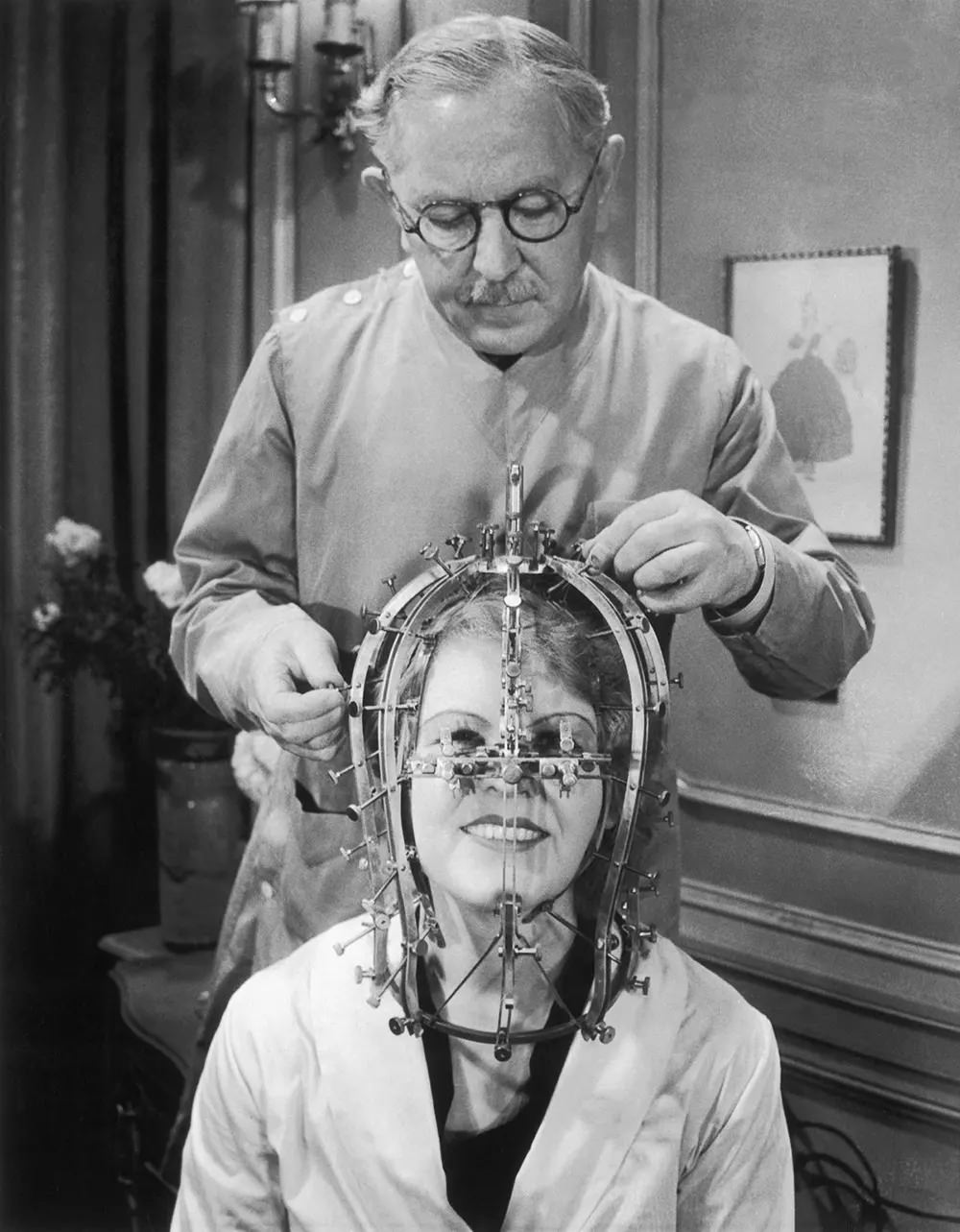
An inventor’s calm concentration fills the room as Max Factor adjusts a metal framework around actress Marjorie Reynolds’ head, his round spectacles and clinical smock reinforcing the sense of a laboratory at work. The device—often called a beauty micrometer or “beauty calibrator”—bristles with screws and measuring points, turning the contours of a face into something that can be plotted, corrected, and refined. Reynolds sits steady beneath the apparatus, a poised smile suggesting both trust in the process and the strangeness of being treated like a living blueprint.
With its cage-like geometry and delicate gauges, the contraption reflects a moment when modern cosmetics borrowed the language of science and engineering to sell precision. Rather than relying solely on artistry, the method implied that beauty could be standardized: cheekbones balanced, noses adjusted by illusion, and asymmetries “fixed” through carefully designed makeup. In the world of early Hollywood glamour and studio lighting, such measurements promised not just attractiveness, but consistency—an on-camera face crafted to meet the era’s ideals.
Behind the spectacle lies a revealing cultural story about technology, celebrity, and the commercial power of appearance. The photo captures the uneasy blend of empowerment and constraint: cosmetics offered actresses tools to control how they were seen, yet also subjected them to exacting scrutiny and narrow beauty standards. Today the image reads as both curiosity and cautionary artifact, an early precursor to the data-driven beauty industry and the enduring quest to quantify what was once simply human.