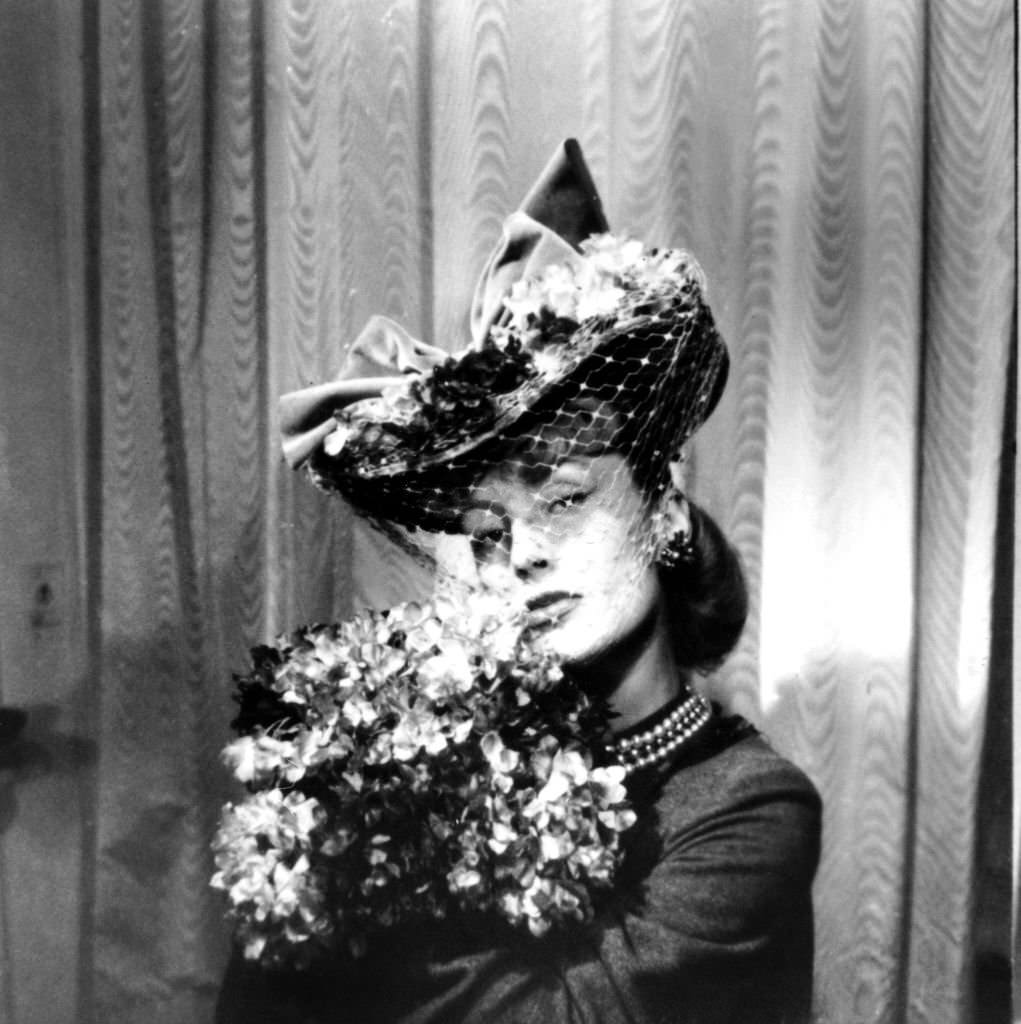
Against a softly patterned backdrop, a Parisian woman poses with a dramatic hat tipped forward beneath a fine veil, its netting casting a delicate lattice across her eyes and cheeks. The brim is adorned with florals and a sculptural bow, turning millinery into a statement piece; her hair is swept back neatly, and a double strand of pearls circles her neck with quiet authority. Her gaze meets the camera with a composed, almost guarded poise that suits the era’s restrained elegance.
Cradled close to her face, a lush bouquet becomes both prop and perfume, its clustered blossoms echoing the hat’s garden-like trim. The styling feels deliberate and couture-minded, aligning with the fashion culture of Paris in 1943—when clothing still carried the city’s reputation for refinement even under wartime pressure. Light and shadow emphasize textures: the veil’s mesh, the satin-like sheen of the hat, and the soft mass of petals that nearly obscures her mouth.
Paris, 1943, reads here not as a postcard but as a mood: intimacy, endurance, and the insistence on beauty as daily ritual. The portrait’s tight framing and studio-like setting draw attention to craftsmanship—millinery, jewelry, and bouquet arranged into a single, symbolic silhouette. For historians of French fashion and wartime culture, the image offers a vivid glimpse of how style persisted, using florals and veiling to project romance, privacy, and resilience.