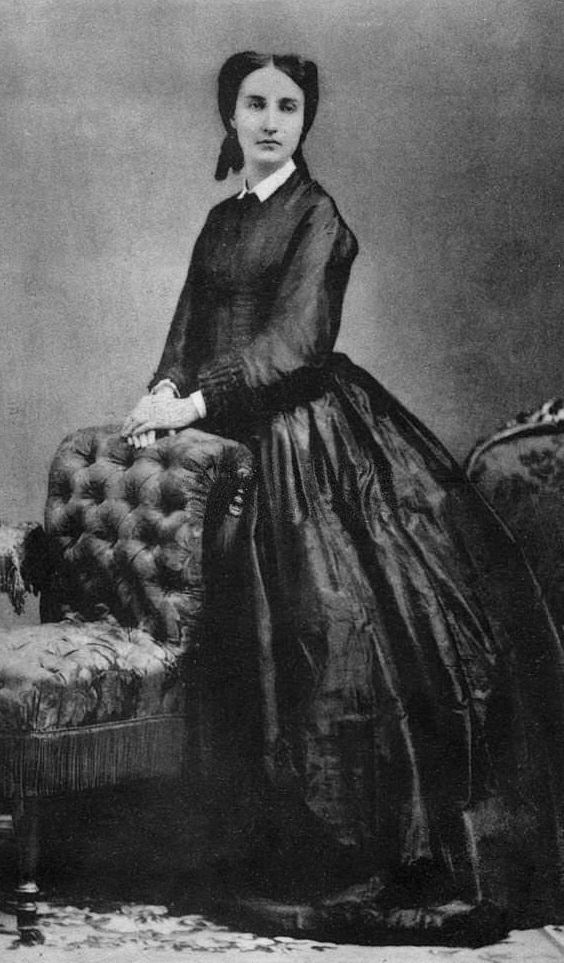
Carlotta, remembered as Empress of Mexico and born Princess Charlotte of Belgium, appears here in a formal studio portrait that emphasizes composure and rank. She stands beside a tufted settee, one hand resting lightly on its back, while her steady gaze meets the camera with the practiced poise expected of European royalty. The plain backdrop and careful lighting keep attention on her figure, turning the sitter herself into the subject of history rather than the setting around her.
Her clothing speaks the language of 19th-century fashion and court culture: a dark, lustrous dress with a fitted bodice and a wide crinoline-supported skirt that pools toward the floor. Long sleeves and a crisp white collar frame the face, while the hair is arranged in a center part with smooth, structured sections that echo the period’s preference for symmetry and restraint. Details like the sheen of the fabric and the silhouette’s architectural volume reveal how clothing functioned as status, taste, and identity.
Linked by title to Leopold I of Belgium, Carlotta’s portrait also evokes the broader web of dynastic politics that shaped the era, when royal daughters were raised for visibility as much as for governance. Studio photographs like this one offered more than likeness; they circulated an image of legitimacy, refinement, and stability at a time when empires and nations were being contested and remade. For readers searching Fashion & Culture history, the picture preserves both a personal presence and a textbook example of crinolines, elite portraiture, and the performance of monarchy in the 1800s.