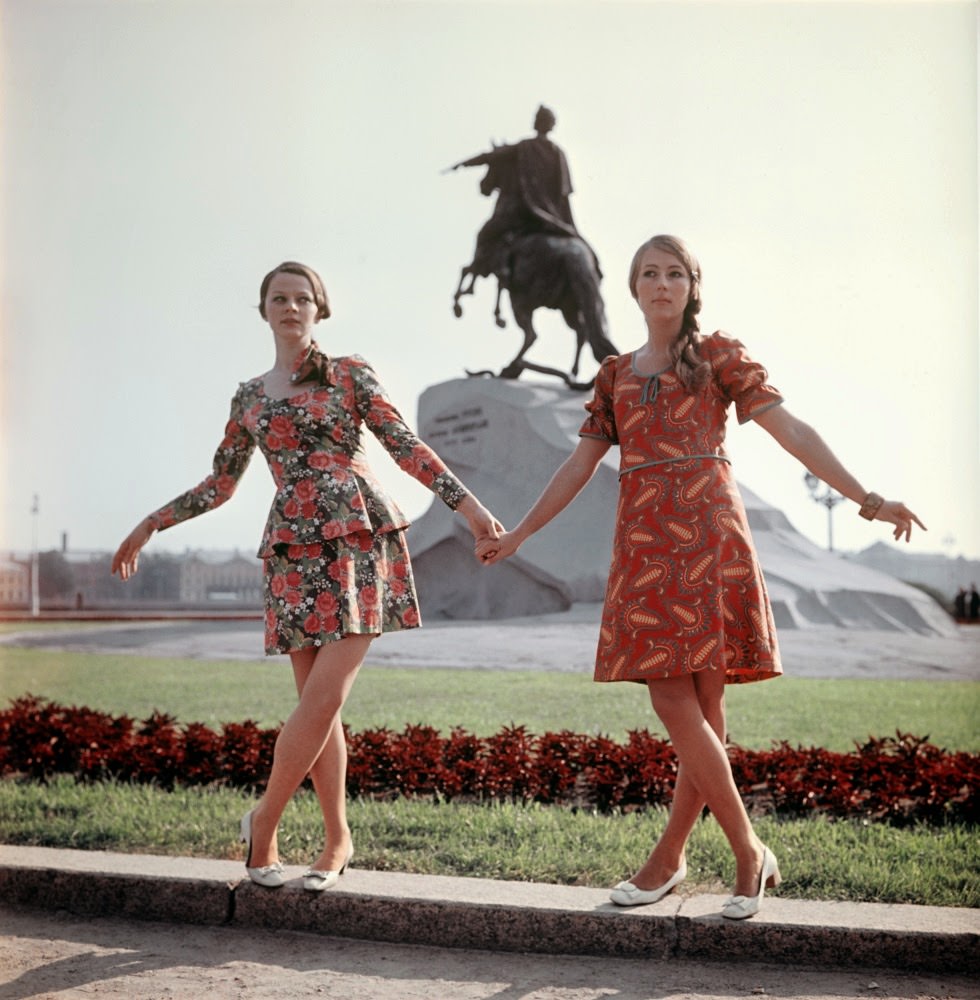
Against an expansive sky and the silhouette of an equestrian monument, two young women pose hand in hand on a city walkway, turning an everyday public square into an impromptu runway. Their stance is choreographed yet relaxed—arms slightly out, feet angled with dancerly balance—suggesting the playful confidence that began to define late Soviet street style. The tidy lawn, low flowerbed, and broad stone curb frame them like a stage, while the distant skyline hints at an urban center without pinning the moment to a single named place.
Bold pattern does the talking: one wears a fitted floral ensemble with a short skirt and structured peplum-like layers, the other a bright dress printed with swirling motifs and finished with puffed sleeves. Both outfits sit firmly in the 1960s–70s silhouette world—short hemlines, clean lines, and eye-catching textiles—paired with neat white heels that read as practical elegance rather than excess. Their hairstyles are carefully arranged, with smooth side parts and braided length, reflecting the era’s preference for polished grooming that complemented graphic fabrics.
What makes the photograph resonate is its blend of fashion and culture, where personal expression stands before monumental history. In the Soviet Union’s changing consumer landscape, clothing often became a quiet statement—resourceful, aspirational, and modern—crafted through ready-to-wear, tailoring, or clever home sewing. For anyone searching women’s fashion of the 1960s-70s Soviet Union, this scene offers a vivid snapshot of how color, print, and youthful poise could brighten a public space and subtly redefine what “everyday” looked like.