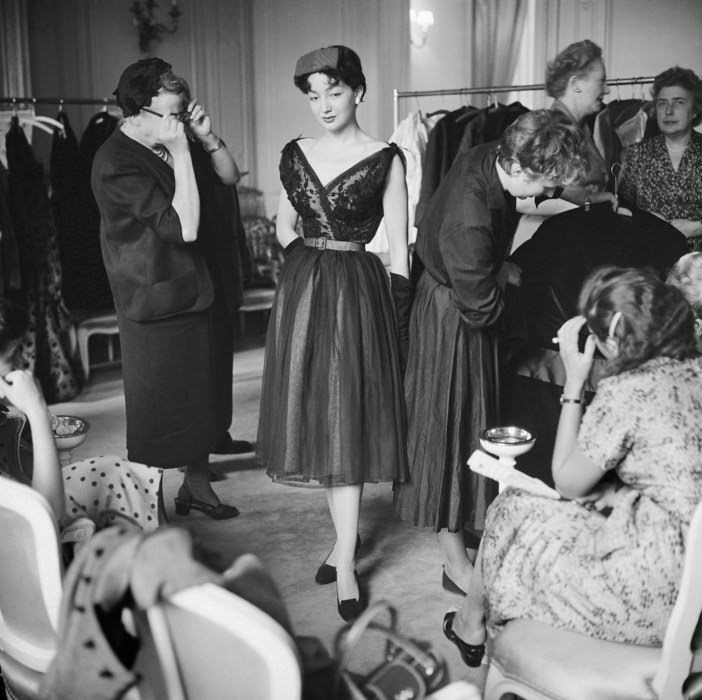
In a crowded couture salon, a model pauses mid-walk while the room leans in—some seated with notebooks and cigarette holders, others standing close enough to judge a hemline by eye. Racks of garments line the walls, turning the space into both showroom and backstage, where luxury is presented alongside the practical business of fashion. The mood is intent rather than theatrical: this is a working performance, staged for people who must translate runway glamour into orders.
The dress itself invites scrutiny, with a fitted, dark bodice and a softly voluminous skirt that falls to mid-calf, cinched by a defined waist and finished with a neat hat and gloves. Around her, buyers examine construction and fabric behavior in motion, tracking how the silhouette holds, how the neckline frames, and how the skirt moves when the model shifts her weight. In the context of Christian Dior’s in-demand Autumn–Winter 1953 haute-couture collection, every seam is a selling point—and every detail a decision.
Behind the elegance sits an industry at full power, where couture functioned as both cultural authority and commercial engine in the 1950s. The photograph underscores how high fashion was negotiated in real time: poised models, disciplined presentation, and professionals measuring taste with ruthless precision. For readers searching Dior haute couture history, 1950s fashion culture, or the business of Paris runway shows, this scene offers a vivid reminder that desire was carefully studied before it was ever purchased.