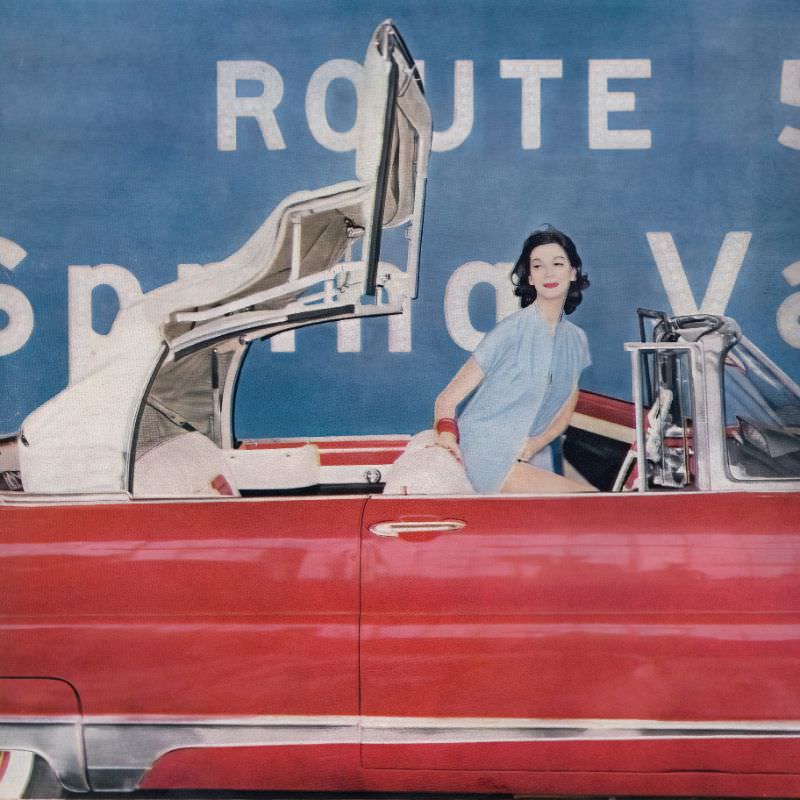
Against a bold blue backdrop of oversized lettering, a model perches in a glossy red convertible with its dramatic top arched upward like a stage prop. The styling is pure mid-century polish: a pale blue dress, carefully set dark waves, and a confident, composed expression that reads as editorial rather than candid. Chrome trim, clean lines, and the car’s saturated paintwork turn the automobile into a fashion accessory, echoing the era’s love affair with modern design.
Gleb Derujinsky’s Harper’s Bazaar work is often remembered for this kind of crisp glamour—where couture and consumer culture meet in a single, impeccably arranged frame. Here, the composition leans on strong geometry: the horizontal sweep of the car’s body, the vertical lift of the roof mechanism, and the graphic typography behind them. Color does much of the storytelling, too, with cool blues set against vivid red, creating a magazine-ready contrast that feels both chic and emphatically 1950s.
In 1956, fashion photography was increasingly about lifestyle as much as clothing, and this editorial image sells the dream of motion, leisure, and status without needing a specific place name. The convertible suggests sunlit boulevards and weekend escapes, while the model’s poised posture hints at effortless sophistication—an ideal that Harper’s Bazaar helped define for its readers. As a piece of fashion and culture history, the photograph stands as a tidy emblem of postwar optimism, when style, technology, and advertising merged into a single glamorous narrative.