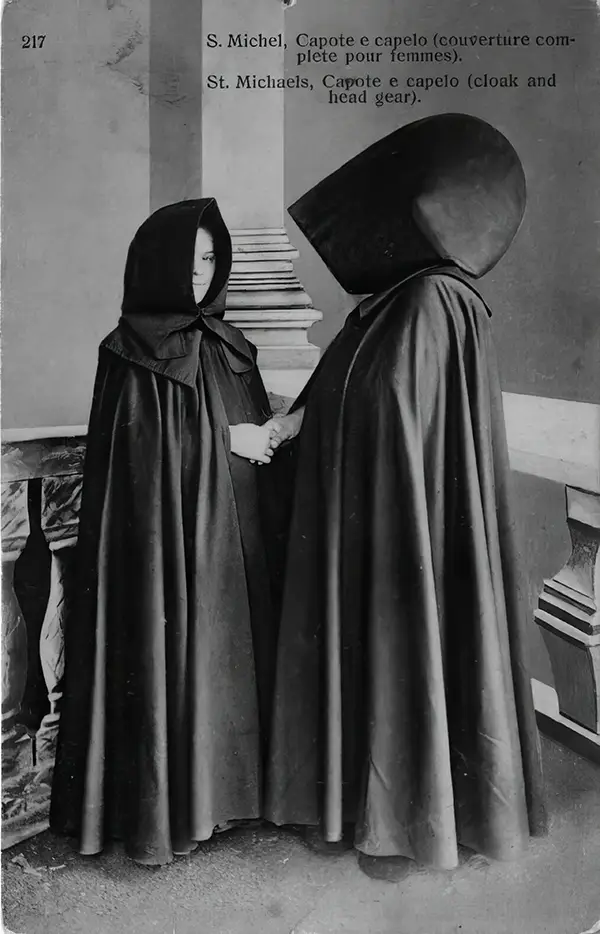
Two women stand wrapped in the dramatic Azorean hooded cape known as the capote e capelo, their dark garments falling in heavy, uninterrupted lines to the floor. One figure faces the camera with her hood framing a calm, direct gaze, while the other turns slightly away, allowing the oversized, sculptural headpiece to dominate her silhouette. The contrast between the plain studio backdrop and the deep folds of fabric makes the clothing itself the subject, turning traditional dress into a study of shape, shadow, and presence.
Printed text at the top identifies “St. Michaels” and describes the ensemble as a “cloak and head gear,” linking the style to São Miguel in the Azores and to the broader Portuguese women’s fashion and culture of the period. More than a simple covering, the capote e capelo functioned as outdoor wear and social signal, combining modesty with a striking sense of anonymity and authority. The high, enveloping hood—almost architectural—suggests how island life, climate, and custom could produce a look unlike anything on the mainland.
Details emerge slowly: the thick collar that settles over the shoulders, the careful drape of the cape, and the way the two women’s hands meet at mid-frame in a quiet, intimate gesture. The composition reads like an ethnographic record meant to catalogue regional costume, yet it also feels theatrical, as if the women are demonstrating how the hood transforms posture and identity. For anyone searching Azorean hood history, Portuguese traditional clothing, or capote e capelo photographs, the image offers a rare, evocative glimpse into lived tradition preserved through early visual documentation.