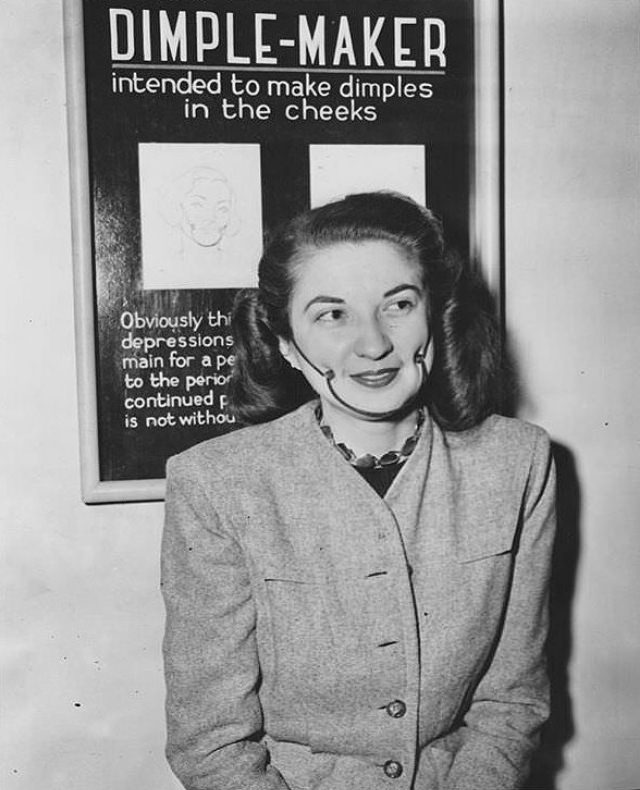
Behind her poised smile sits a bold promise in block letters: “DIMPLE-MAKER,” a wall display announcing a device “intended to make dimples in the cheeks.” The woman models the contraption like a showroom demonstration, her hair carefully styled and her tailored jacket buttoned neat, while a metal frame hugs the line of her jaw. Two small pads press into her cheeks, turning an everyday expression into a mechanical project.
Up close, the apparatus reads as part orthodontics, part beauty gadget—springy metal arms and pressure points engineered to “train” the face into a fashionable look. The promotional sign and diagrams in the background suggest a consumer pitch as much as a medical one, reflecting an era fascinated by modern inventions and body optimization. Even without a named setting, the scene feels like a public exhibit or product launch, where novelty and aspiration were packaged together.
Fashion and culture in the 1930s often treated femininity as something that could be improved with the right tool, and this dimple-making device embodies that faith in manufactured charm. The image balances humor with unease: a cheerful expression framed by a clamp designed to reshape it, selling dimples as an attainable accessory. As a piece of vintage beauty history, it’s a striking reminder that the quest for a “perfect” face long predates social media—only the hardware has changed.