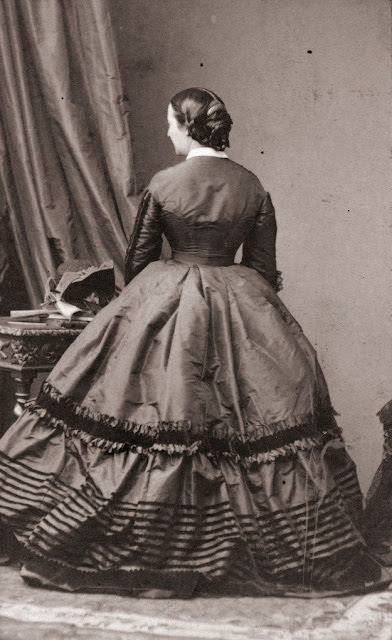
Turned slightly away from the viewer, a Victorian woman stands in a studio setting, her silhouette defined by the era’s unmistakable hourglass line. The fitted bodice narrows to a small waist before opening into a full bell-shaped skirt, likely supported by layers beneath, while her hair is arranged in a smooth, low style that emphasizes neatness and control. Even without a front view, the posture and careful grooming suggest the ritual of being seen—composed, respectable, and fashion-conscious in the late 1800s.
Details of dressmaking reward a closer look: the skirt’s breadth is finished with bands and gathered trim, creating rhythmic stripes and texture near the hem. The fabric catches light in broad planes, hinting at a sturdy, formal material suited to social calls and portrait sittings rather than labor. A small table and heavy drapery frame the scene, typical of nineteenth-century photography studios where props and curtains helped turn a plain room into an imagined parlor.
Beyond aesthetics, the photograph speaks to Victorian culture’s fascination with propriety and presentation, where clothing functioned as a visible language of class, taste, and domestic ideals. The exaggerated skirt shape and structured back view reflect the period’s engineering of femininity—fashion that shaped the body as much as it adorned it. For anyone exploring late 1800s women’s fashion, Victorian etiquette, or historical costume design, this portrait offers a vivid, grounded glimpse into how style and identity were stitched together in everyday life.