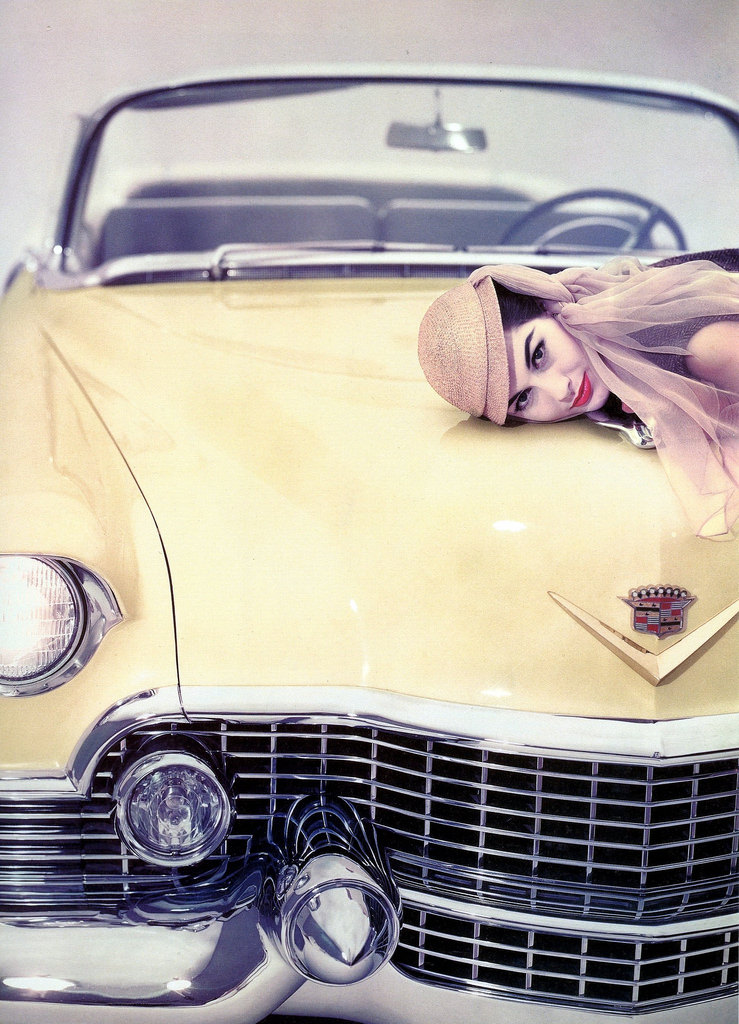
Glossy paint and mirror-bright chrome set the stage for a 1954 fashion moment credited to Blumenfeld, where Ancy Berg’s poised face rests against the broad hood of a classic convertible. The car’s crest and V-shaped ornament anchor the composition, while the wide grille and rounded headlamps announce mid-century design at its most theatrical. Soft color and controlled studio light turn metal into jewelry, making the automobile as much a prop of glamour as a symbol of modern life.
Ancy Berg’s styling leans into the decade’s taste for polish: a small hat, sheer veil, and vivid lipstick that punctuates the creamy bodywork beneath her. The pose is playful yet composed, as if the model is both admiring and claiming the machine’s promise of speed, leisure, and status. By bringing face, fabric, and fender into such close proximity, the photograph collapses fashion photography and automotive advertising into one seductive tableau.
Between runway fantasy and showroom aspiration, this image speaks to postwar consumer culture, when elegance was marketed through surfaces—lacquer, satin, and the illusion of effortless luxury. Collectors and researchers of 1950s photography will recognize how Blumenfeld’s eye for graphic structure and sheen elevates a simple setup into a lasting icon of style. For readers drawn to vintage fashion, classic cars, and mid-century visual culture, “Ancy Berg, photo by Blumenfeld, 1954” remains a striking reminder of how desire was designed.