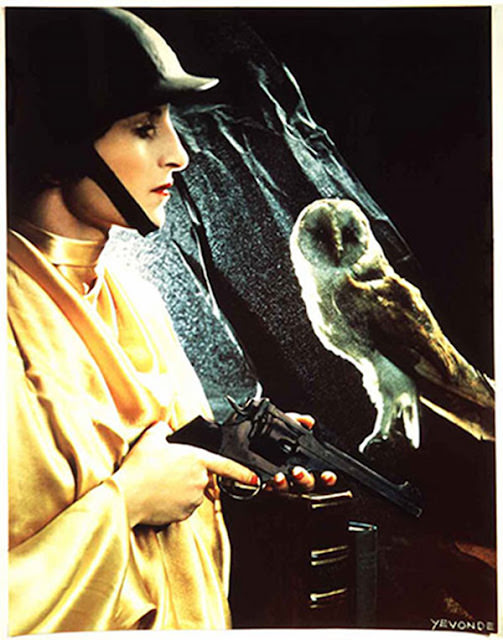
Profiled against a dark, theatrical backdrop, Lady Michael Balcon appears as Minerva with a poised, almost sculptural stillness. A helmet frames her face in sharp silhouette, while a flowing, satin-like robe catches the light in warm tones that feel both luxurious and otherworldly. Her calm gaze and firm posture suggest authority rather than spectacle, turning a costume into a convincing embodiment of the Roman goddess of wisdom and war.
An owl—Minerva’s traditional companion—perches nearby, its pale feathers glowing against the shadows and lending the scene an uncanny, living presence. In her hands rests a pistol, an unexpected modern prop that heightens the tension between classical mythology and contemporary life, and makes the portrait read as both allegory and fashion statement. The controlled lighting and rich color styling, associated with Madame Yevonde’s celebrated “Goddesses” series, give the composition a cinematic depth that still feels startlingly modern.
Beyond its striking surface, the photograph reflects a moment in early 20th-century fashion and culture when studio portraiture embraced bold experimentation with identity, performance, and power. Mythological dress becomes a vehicle for social self-invention, merging classical symbolism with the sleek confidence of the interwar era. For viewers searching for Madame Yevonde color photography, 1930s fashion portraits, or myth-inspired studio imagery, this interpretation of Minerva stands out as a vivid blend of elegance, modernity, and mythic charge.