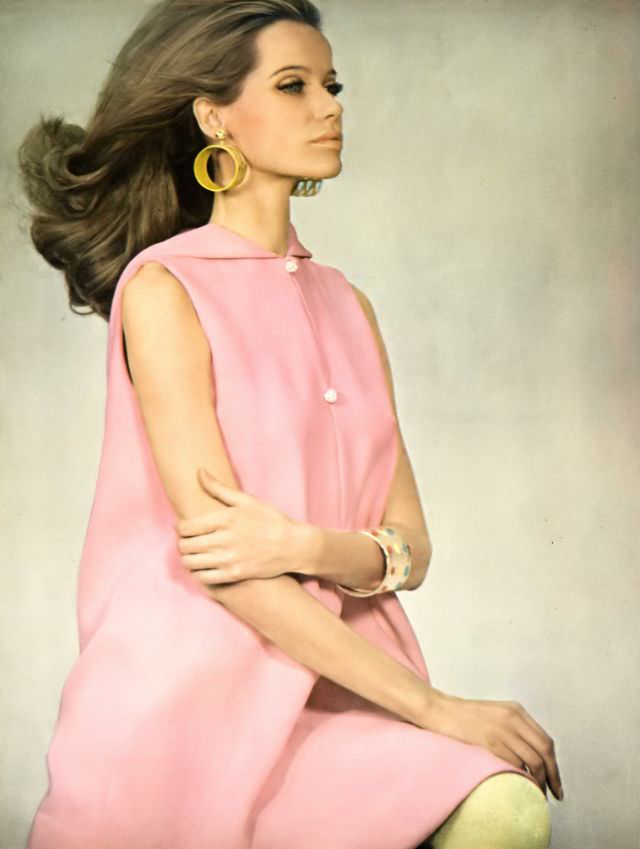
Veruschka appears in profile, poised and distant, her gaze turned beyond the frame as if already moving into the next scene. A soft pink crêpe dress falls in a clean, sculptural line, its hooded collar resting like a cape over her shoulders and emphasizing the long, elegant neck so often celebrated in 1960s fashion imagery. The palette is restrained—pastel fabric against a pale studio background—so that shape and attitude do most of the talking.
Large circular earrings in a bold yellow tone punctuate the look with graphic confidence, while a wide patterned cuff bracelet adds a second note of modernist jewelry. Her hair, swept back in a full, polished wave, suggests motion even in stillness, reinforcing the era’s fascination with controlled glamour and cinematic presence. The sleeveless cut and minimal front buttons keep the silhouette crisp, letting the crêpe’s smooth surface read as both youthful and refined.
Published for Vogue in 1967, the portrait sits squarely in a moment when fashion photography leaned toward simplicity, strong profiles, and uncluttered settings that made clothing feel like design rather than decoration. The styling balances softness and severity—pastel color paired with assertive accessories—capturing the decade’s shift toward streamlined luxury. For historians of fashion and culture, it remains a vivid reference point for late-1960s editorial elegance, where one dress, one pose, and one precise light could conjure an entire mood.