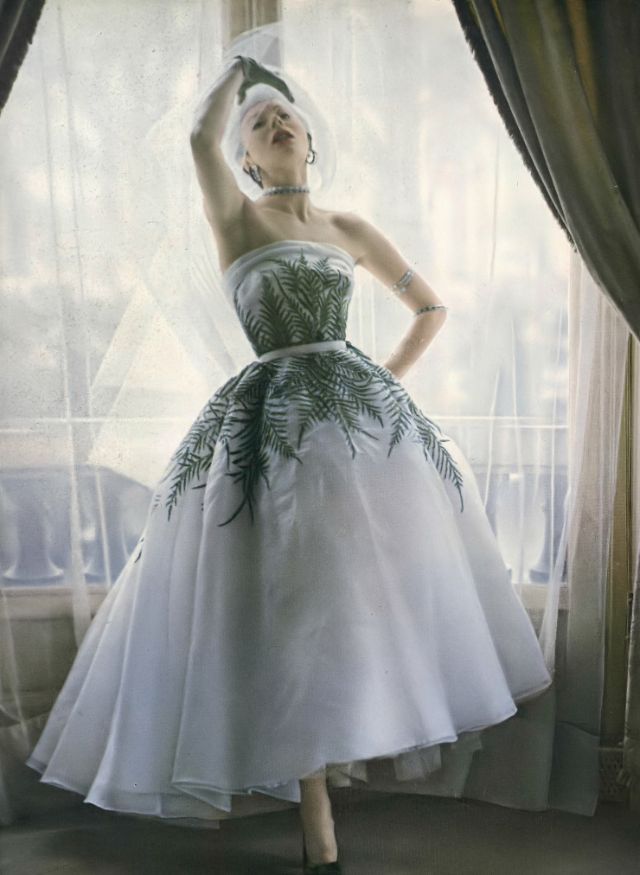
Bettina is posed like a stage heroine before a bright window, her arm lifted to her forehead as if caught in a moment of heat or reverie. The light pours through gauzy curtains and turns the scene into a soft haze, while a darker drape at the edge frames her silhouette. Even without a bustling runway, the posture and setting read as pure haute couture drama, designed to make fabric and attitude speak first.
The organdy dress by Jacques Fath swells into a crisp, mid-century bell shape, its strapless bodice and cinched waist emphasizing the sculptural “New Look” ideal of 1950 fashion. Across the pale surface, delicate fern traceries—suggested by the title to be embroidered and touched with sequins—spread like botanical shadows, concentrating around the torso and cascading onto the skirt. A slim belt ties the composition together, and the styling is finished with jewelry at the neck and arm plus dark gloves, giving the airy dress a sharp, elegant counterpoint.
Seen today, the photograph doubles as a document of postwar Paris couture and as a portrait of the modeling style that helped make Bettina Graziani an icon of fashion culture. The interplay of transparency and structure—sheer curtains, luminous organdy, and the firm geometry of the skirt—captures the era’s fascination with femininity as both softness and architecture. For vintage fashion enthusiasts searching Jacques Fath designs, Bettina photos, or 1950s haute couture, this image distills the period’s glamour into a single, memorable tableau.