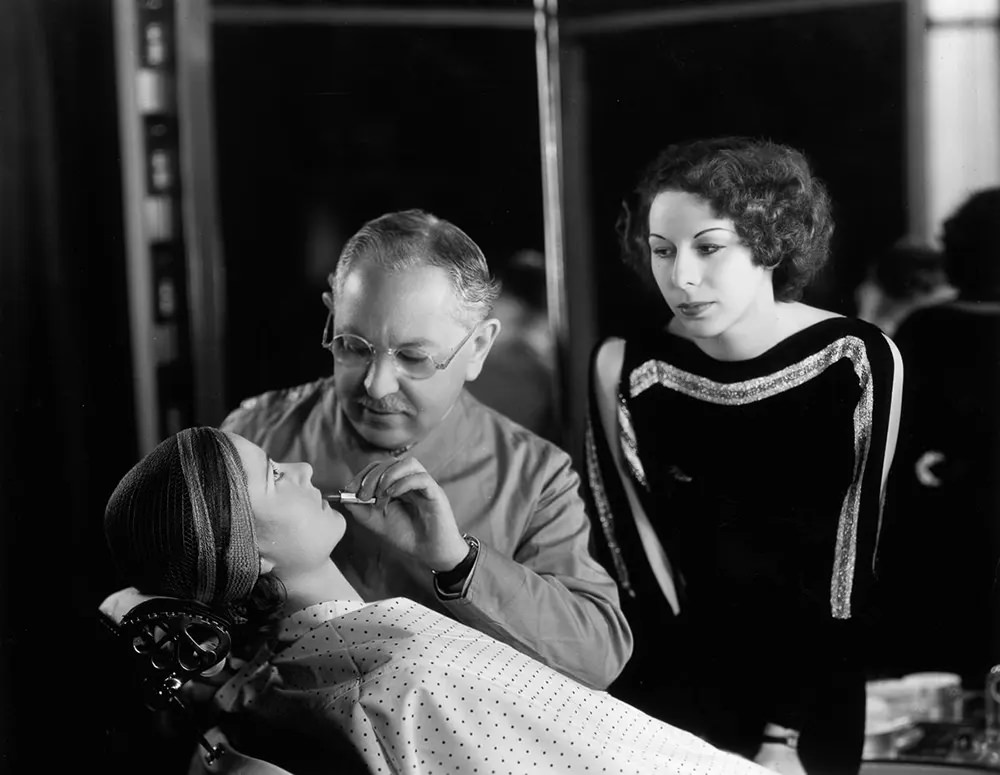
Under the glow of a studio-like interior, a bespectacled makeup specialist leans in with steady concentration, applying lipstick to a reclining model whose head is supported by an ornate chair. The model’s eyes are closed and her posture is still, suggesting the careful, step-by-step precision expected of professional cosmetics in the early 20th century. A second woman stands close by, watching intently, her sleek waves and embellished dress reflecting the era’s fashionable silhouette.
Hands and tools take center stage here: the lipstick is not casually swiped on, but placed with the deliberate control of an artist working to a plan. The composition emphasizes technique—angle, line, and symmetry—more than glamour, turning an everyday beauty routine into something instructional and almost clinical. Even without a visible product label, the scene reads as a demonstration meant to be observed, learned, and repeated.
Dated to 1930, the photograph sits at the crossroads of cosmetics, cinema-influenced style, and the growing authority of beauty experts who promised “correct” features through method and measurement. It also echoes the decade’s fascination with calibrating the face—an approach that treated makeup as a system for analyzing and refining appearance rather than mere decoration. As a piece of fashion and culture history, it offers a vivid glimpse into how modern lipstick application was taught, performed, and marketed as both art and science.