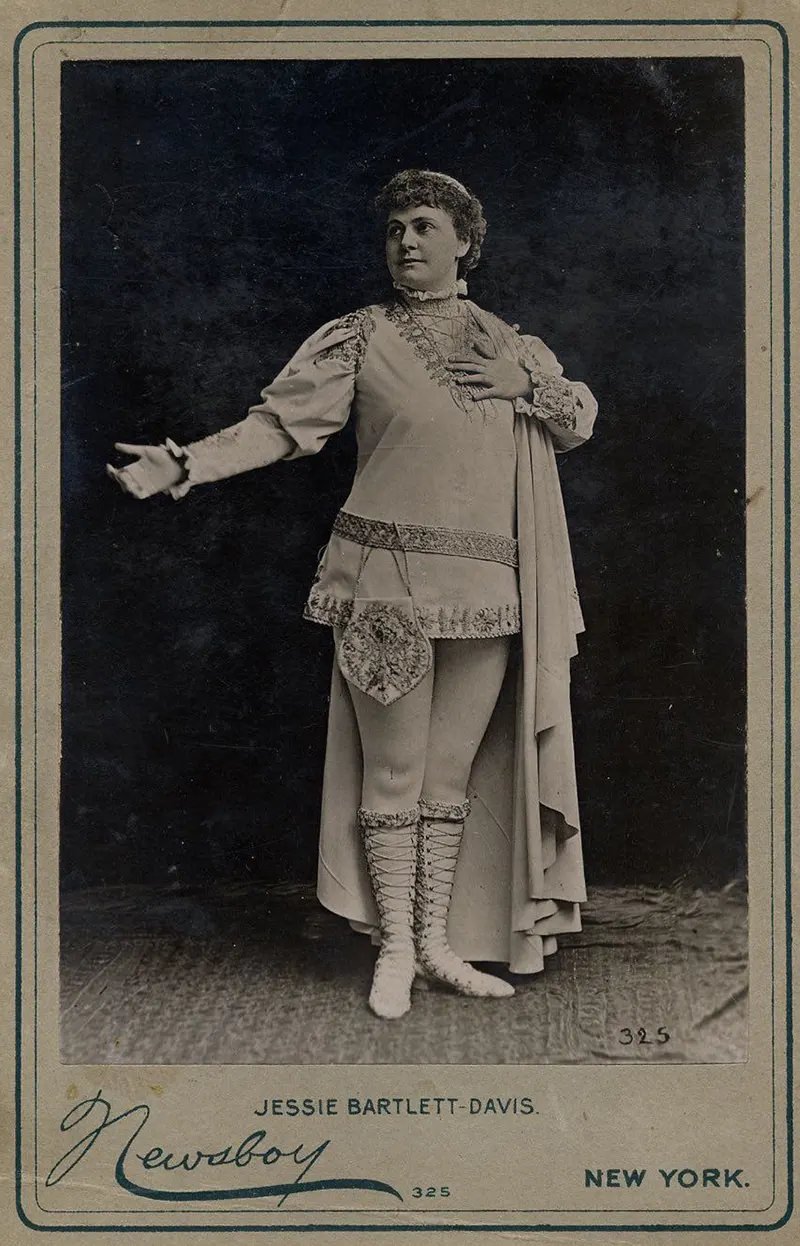
Poised against a dark studio backdrop, Jessie Barlett-Davis adopts a performer’s stance—one arm extended as if mid-line, the other drawn to her chest in a gesture of courtly drama. The theatrical lighting catches the pale fabric and ornate trim, letting embroidered edges and decorative bands read clearly despite the subdued set. A printed caption along the card identifies her, anchoring the portrait in the world of promotional photography that circulated widely in late Victorian popular culture.
Costume is the real subject here, and its medieval flavor feels deliberate: a tunic-like top, fitted sleeves, and a long drape falling from one shoulder evoke the stage’s idea of a 15th-century silhouette rather than strict historical accuracy. High lace-up boots and a conspicuous, patterned pouch at the hip add to the pageantry, mixing practicality with spectacle in the way burlesque and variety productions often did. The overall effect suggests “historical” at a glance—an instantly readable pastiche designed to play to audience expectations from the 1890s.
Such portraits were part advertisement, part fantasy, and part fashion document, capturing how performers used clothing to signal character, era, and mood in a single frame. The careful layering, bold accessories, and confident pose speak to a moment when stage costume helped drive broader trends in taste, from medieval revival motifs to the appetite for romanticized history. For researchers of Victorian theater, burlesque dancers, and 19th-century fashion culture, the image offers a vivid example of how the past was reinvented for entertainment and sold through the camera’s lens.