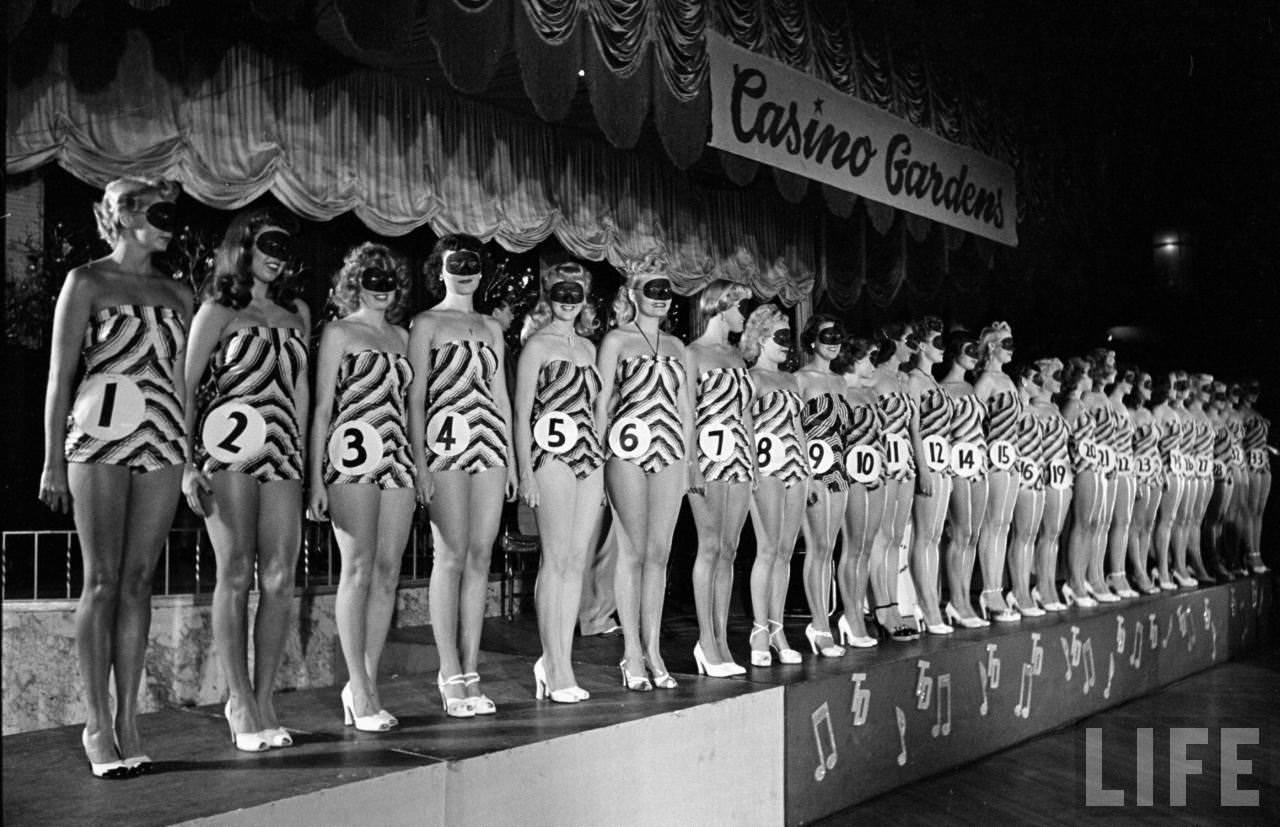
Under the glow of stage lights at Casino Gardens, a long line of contestants stands poised in matching striped swimsuits, each marked with a large number for the judges and crowd to track. Dark eye masks lend the event a theatrical, almost carnival air, while high heels and carefully set hair signal the polished glamour prized in postwar American fashion culture. Draped curtains and a raised platform turn what could be a simple lineup into a spectacle designed for cameras and applause.
Held in Los Angeles in 1949, the “Beautiful Legs” competition reflects a moment when public pageantry and commercial entertainment blended seamlessly with beauty standards. The emphasis on legs—isolated, ranked, and compared—speaks to the era’s fascination with idealized proportions, showroom sheen, and the growing influence of advertising aesthetics. Even the uniform styling suggests how individuality was often muted to make bodies easier to evaluate, a stark reminder of how contests shaped—and narrowed—popular notions of attractiveness.
For modern viewers, the photograph reads as both kitsch and cultural evidence: a snapshot of nightlife venues, stagecraft, and the mid-century appetite for novelty competitions. The orderly row of numbered entrants captures the mechanics behind the glamour, where performance, presentation, and judgment were part of the entertainment itself. As an artifact of Los Angeles fashion and culture, it preserves the look of 1949 show business while quietly revealing the social values that put beauty on display.