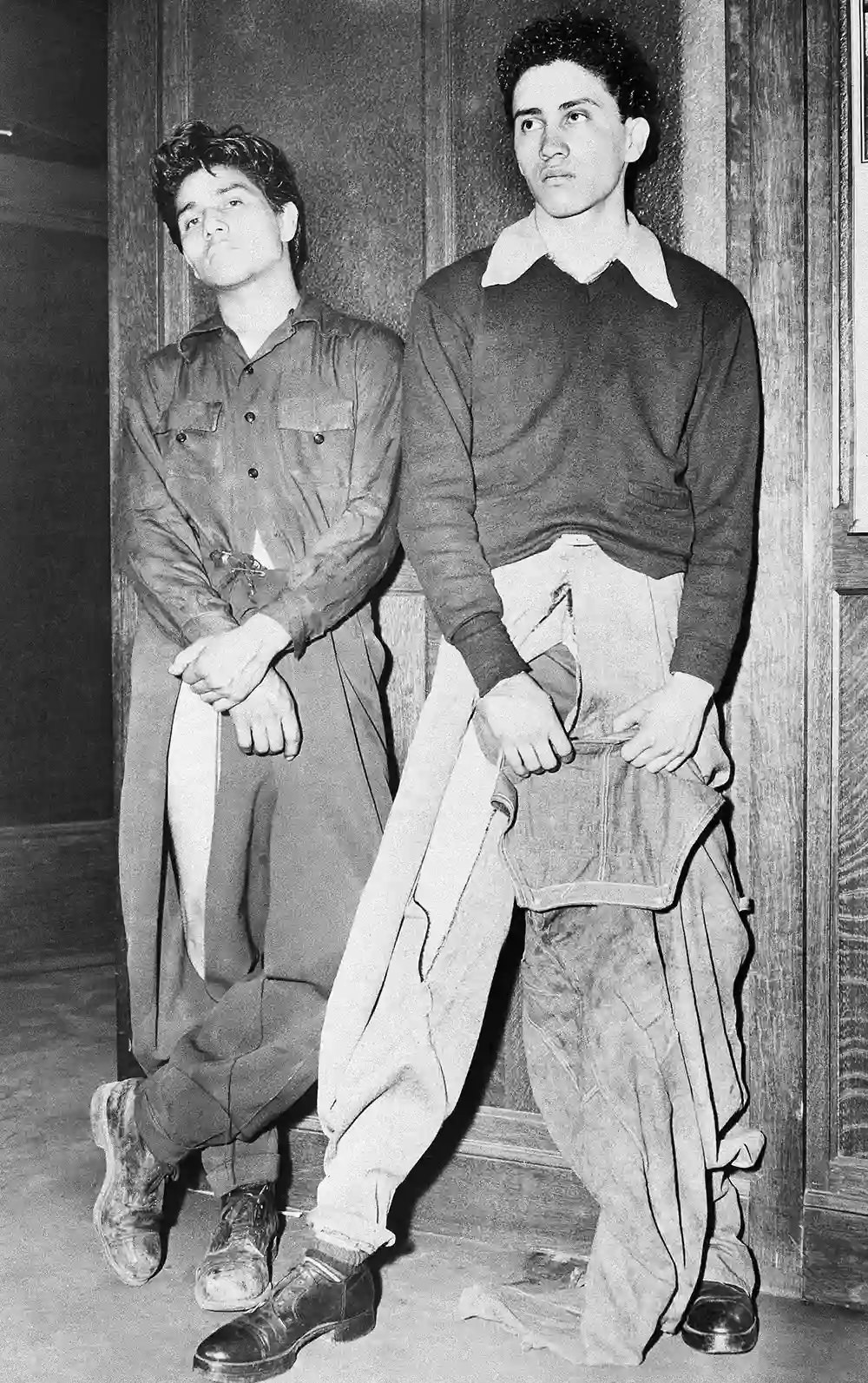
Inside the Los Angeles Police Department, Noe Vasquez and Joe Vasquez stand against dark wood doors with the guarded stillness of young men who have just been through something they did not choose. Their expressions are tight and distant—one looking slightly away, the other meeting the room with a hard, exhausted stare—while their posture suggests both fatigue and defiance. The setting is plain and official, the kind of interior where personal turmoil is reduced to a report, a statement, a photograph.
Clothing becomes the evidence in this moment, and also the message: the fabric hangs awkwardly, cut and damaged, with long slashed panels that draw the eye down the length of their trousers. One man grips what appears to be a torn garment or jacket, held like a reminder of the assault rather than a mere accessory. The camera lingers on the disorder of cloth and the scuffed shoes below, turning style into a record of violence and public humiliation.
Dated in the title to June 10, 1943, the scene points directly to the Zoot Suit Riots era in Los Angeles, when youth fashion, wartime tensions, and racialized suspicion collided in the streets near places like Union Station. Reports of sailors targeting young Mexican American men by ripping and slashing their outfits made headlines, and police stations became stages where victims were processed, questioned, and displayed for the public gaze. Read today, the photograph is a stark piece of Los Angeles history—an image of two brothers caught between cultural identity and a citywide panic over what their clothes were said to represent.