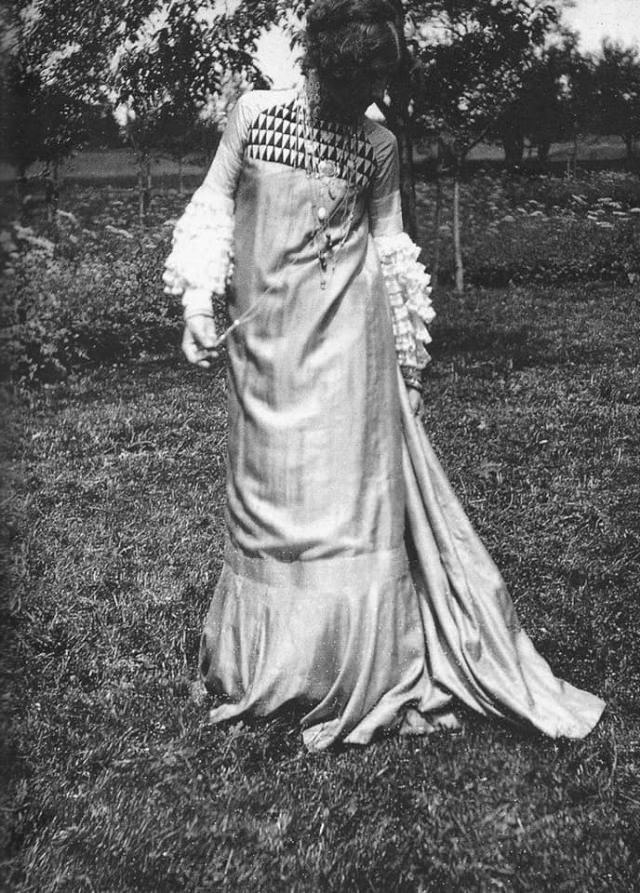
Beneath a canopy of trees, a lone figure stands in a grassy garden, head slightly bowed as if caught mid-thought. The long gown falls in a smooth, uninterrupted line before pooling into a soft train, its sheen suggesting a carefully chosen fabric meant to move with the body rather than constrain it. At the shoulders and cuffs, airy ruffles and a bold geometric yoke break the plain surface, turning the dress into a conversation between ornament and restraint.
Details like the patterned panel across the chest and the relaxed fit evoke the early modernist shift in women’s fashion, when designers began challenging rigid corsetry and fussy silhouettes. The wearer’s posture—unposed, almost candid—pairs naturally with clothing that reads as practical elegance, a look associated with reform-minded dress and the progressive arts-and-crafts spirit. Even in grainy monochrome, the contrast between crisp motifs and fluid drape hints at a designer’s eye for both structure and freedom.
Emilie Flöge’s fashion career, often discussed within the wider world of Fashion & Culture, is illuminated by images like this that emphasize design as lived experience rather than mere display. Rare photographs help trace how avant-garde style circulated beyond salons and studios, appearing outdoors and in everyday settings where garments could be tested by light, wind, and movement. For readers searching Emilie Flöge rare photos, historic dress reform, or early twentieth-century women’s fashion, this scene offers a tactile glimpse of modernity taking shape—one seam, one motif, one flowing hem at a time.