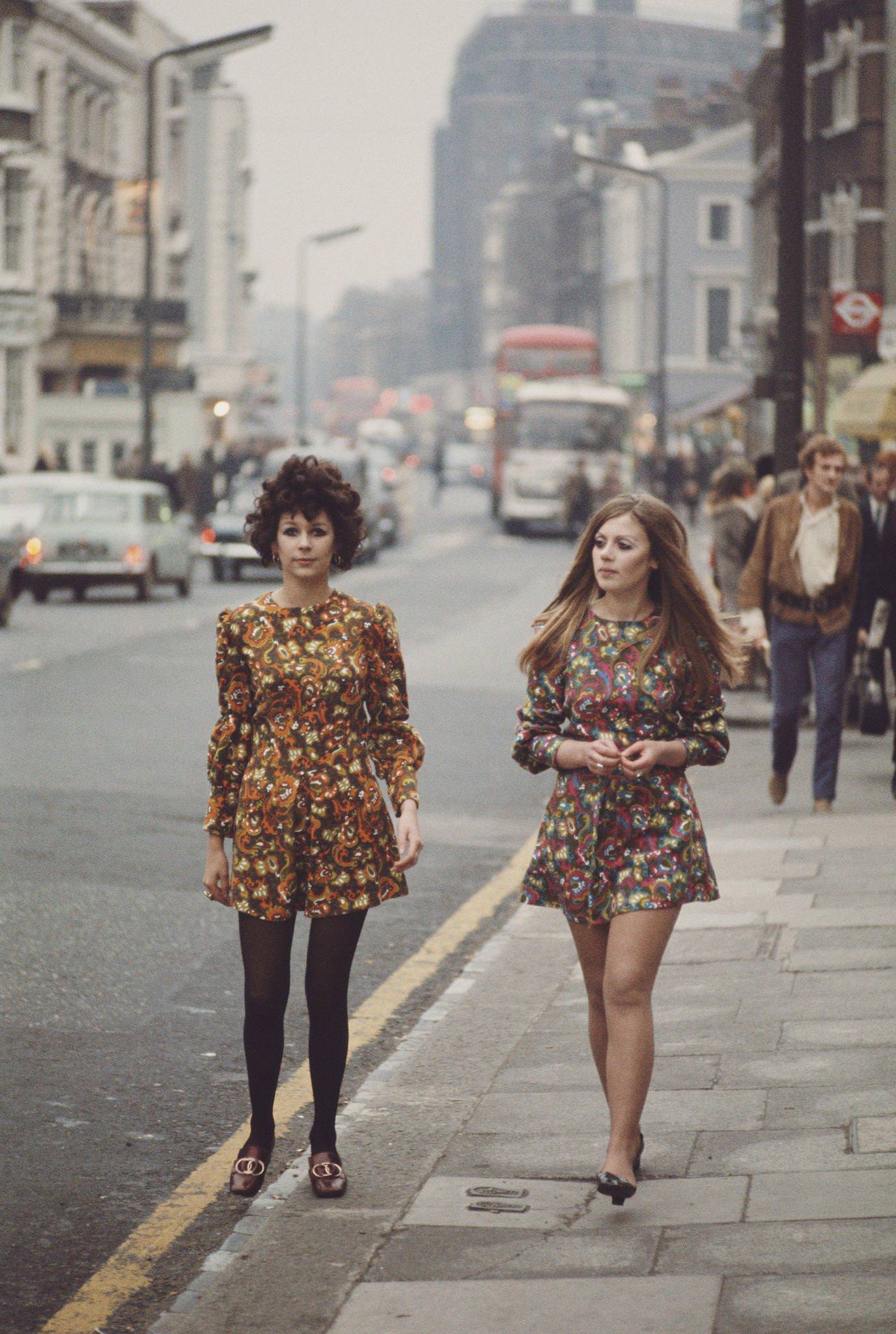
Along the King’s Road in Chelsea, two young girls stride toward the camera through the steady churn of London traffic, their floral mini dresses commanding attention against a muted streetscape. Long sleeves, bold psychedelic prints, and short hemlines place the scene firmly in the fashion revolution of the late 1960s, when youth style moved from the margins to the main thoroughfares. Behind them, buses and cars blur into the grey distance, underscoring how colour and pattern became a kind of everyday spectacle on the city’s pavements.
One wears dark tights and buckle shoes, her dress a dense tapestry of warm-toned swirls that reads almost like moving wallpaper, while her companion’s brighter, jewel-like print catches the light as she walks bare-legged in low flats. Their hairstyles—one in a rounded, voluminous curl, the other long and straight—add a second layer of period detail, echoing the era’s mix of polished mod influences and freer, emerging hippie aesthetics. The girls’ composed expressions and purposeful pace suggest confidence, as if the sidewalk itself were a runway.
November 1967 was a moment when London’s “Swinging” reputation was being written as much by ordinary pedestrians as by boutique windows and magazine spreads. King’s Road had become shorthand for experimentation—where new fabrics, daring silhouettes, and playful prints signaled modernity, independence, and generational change. In this single street-level view, the history of 1960s British fashion and youth culture feels immediate: vivid clothes set against the everyday city, a snapshot of style becoming social statement.