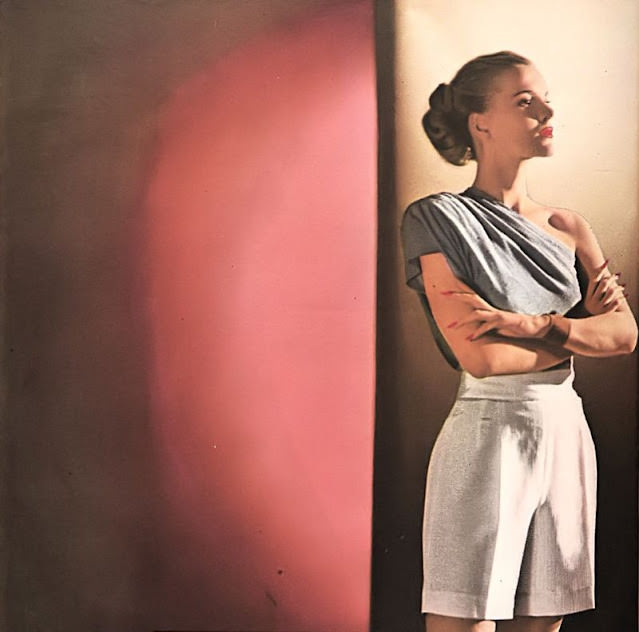
Poised against a softly lit, color-blocked backdrop, Selene Mahri turns in profile with her arms folded, projecting the cool assurance that defined mid-1940s fashion imagery. Her hair is swept into a smooth updo, and the makeup and posture read as unmistakably Vogue: polished, modern, and controlled, with the studio lighting carving a clean silhouette along her cheek and shoulder.
Tina Leser’s design here balances simplicity with sculptural intent, pairing a draped, asymmetrical top that slips elegantly across one shoulder with tailored shorts that sit high at the waist. The fabric falls in calm, architectural folds, suggesting a designer attentive to classical line while still speaking to a contemporary, postwar appetite for ease and mobility. The restrained palette and uncluttered styling keep attention on cut and proportion, the quiet hallmarks of sophisticated 1940s sportswear.
In the context of Vogue in 1945, the look feels like a bridge between wartime practicality and the renewed confidence of peacetime wardrobes. The crisp tailoring and bare arms suggest readiness—clothes meant for real movement—while the drape and stance preserve the aspirational glamour that fashion magazines sold so expertly. For readers interested in 1940s style, Tina Leser, or the evolution of American fashion design, this image offers a vivid snapshot of how tradition and modernity met in a single, carefully composed frame.