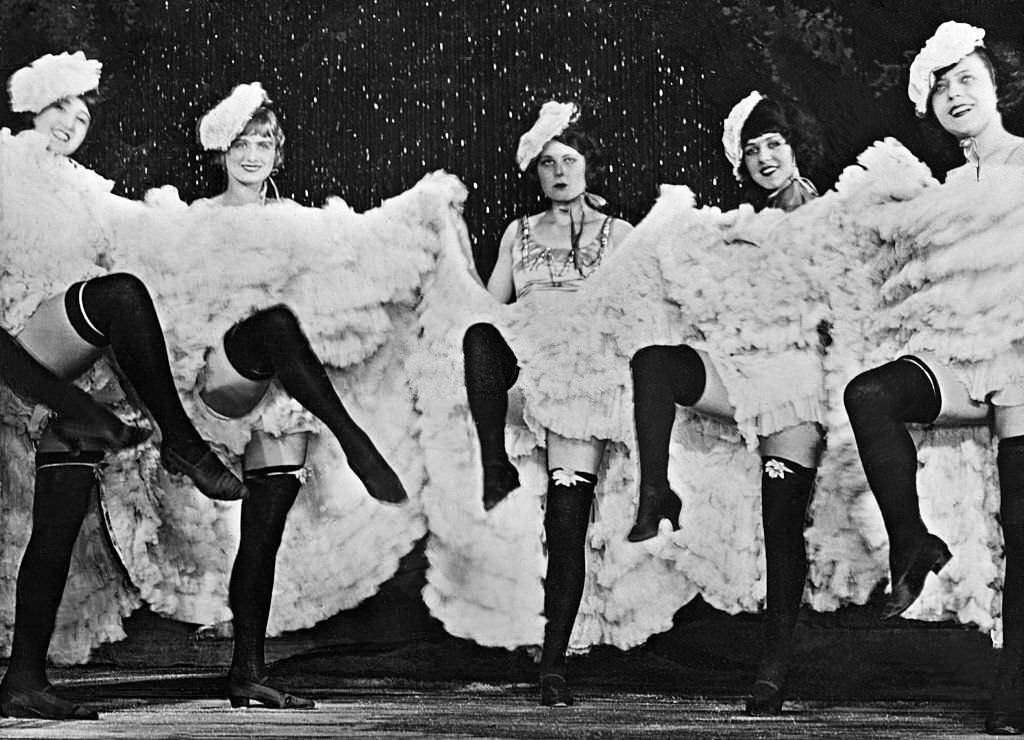
Feathers and fringe erupt across the stage as a line of revue girls snaps into the cancan’s signature high kicks, their lifted skirts forming a rippling white wall against a dark backdrop. Stockings, heeled dance shoes, and the crisp geometry of bent knees and pointed toes emphasize the athletic precision behind what audiences often remember as playful spectacle. Even in a still frame, the choreography reads as synchronized energy—each dancer caught mid-beat, balancing poise with momentum.
At Berlin’s Wintergarten Variety Theater in 1928, such performances belonged to a thriving nightlife culture that prized modern entertainment, glamour, and technical showmanship. The costumes—bright, fluffy layers paired with sleek hosiery and small headpieces—signal the revue tradition of carefully staged extravagance, where chorus lines were as much a visual design as they were a dance ensemble. Variety theater offered a curated world of music, comedy, and dance, and the cancan delivered its bold, crowd-pleasing climax through speed, stamina, and unity.
Beyond its famous kicks, the cancan in the early 20th century functioned as a lens on fashion and changing attitudes toward performance and femininity. This photograph preserves the era’s stagecraft: the deliberate symmetry of the lineup, the theatrical contrast of light costume against shadowed scenery, and the blend of flirtation with disciplined technique. For anyone researching Weimar-era Berlin, cabaret and variety theater history, or the evolution of revue dance, the image stands as a vivid record of entertainment culture at full flourish.