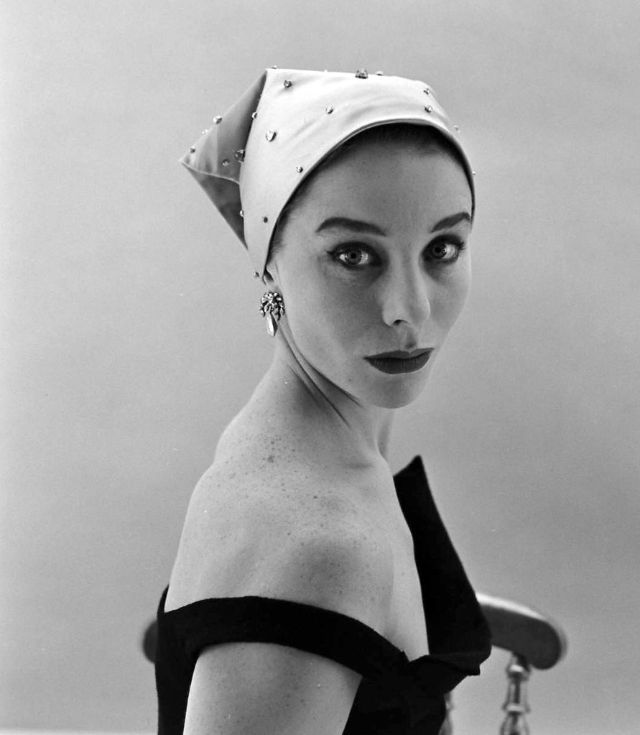
Bettina turns toward the camera with a poised, almost theatrical stillness, her bare shoulders framed by an off-the-shoulder dark gown that reads as pure early-1950s elegance. The studio background is spare and softly lit, pushing every ounce of attention to her face—arched brows, luminous eyes, and a composed mouth that suggests both confidence and restraint. A sculptural earring catches the light at her jawline, adding a sharp sparkle to the otherwise smooth, satin-like textures.
At the center of the portrait sits the Givenchy headscarf, covered with paillettes that dot the fabric like tiny points of reflected light. Tied close and shaped to the head, it recalls the period’s fascination with sleek, controlled silhouettes, where accessories carried as much drama as a full ensemble. The subtle glimmer of sequins against the pale scarf creates a striking contrast in monochrome, turning a simple wrap into a couture statement.
February 1952 places the image in a moment when Paris fashion was refining postwar glamour into something cleaner and more modern, and Bettina’s look embodies that shift. The photograph works as both fashion documentation and cultural artifact: a study in how haute couture styling, studio portraiture, and model presence combined to define an era’s ideals. For readers searching mid-century French fashion, Givenchy accessories, or Bettina’s signature style, this portrait distills the period’s sophistication into one unforgettable pose.